Showing posts with label Accra. Show all posts

Sunday, November 22, 2020

Air Liban to Europe and Africa, c.1952


 Prior to becoming Middle East Airlines, the flag carrier of Lebanon was known as Air Liban. Formed in 1945, it quickly expanded across Southwest Asia, Europe and into Africa as reflected in the destination list on this vintage brochure: Near East destinations include Aleppo and Baghdad, and fourth city is listed Jerusalem—a somewhat remarkable historical phenomenon, although this likely references the old Atarot Airport, at the time located in the Jordanian-annexed West Bank. Regardless, "Jerusalem" makes its Timetablist debut here. 

Further into the Gulf extends a spine of Jeddah—Dhahran—Doha—Kuwait; it is important to realize that, long before the rise of thee Gulf super-carriers, MEA/Air Liban was the primary airline of the Arab World, as its expansive name implies. 

Looking Westward, Air Liban ran its "swift Super DC-6C planes" to Nicosia, Ankara, Istanbul and to its only Western European capital, Paris, while send a second route to Cairo and Tripoli, with its most southernly service across the Red Sea to Khartoum, then spanning the vast Sahara to reach Kano, Lagos, Accra, Abidjan, and finally terminating at Dakar. This unusual number of West African destinations linked the Syrian-Lebanese commercial diaspora of coastal urban West Africa to their homeland. 

Wednesday, July 15, 2020

Arik Air: 3x Weekly Dakar—Lagos, November 2018


As is the customary life arc for a Nigerian airline, Arik Air is much diminished from its former glory; its network is limited to the African continent, and at that it is limited by West Africa's classic checkerboard conundrum, in which there are very few links between Anglophone and Francophone nations. 

Lagos, Accra, Abidjan and Dakar are the pairs of cities which most frequently cross over this barrier, and recently Arik Air has been the Anglophonic regional carrier preforming such operations, as shown here in a floor banner at the recently-completed Blaise Daigne International Airport far outside of Dakar. The deep blue polyurethane sheet details Arik's thrice-weekly link to Lagos, which operates late at night, departing Lagos on Wednesdays, Fridays, and Sundays and returning after midnight on Mondays, Thursdays, and Saturdays. Abuja and Accra are shown but apparently only for suggestive purposes. The airline's own winged logo is absent. 

Wednesday, May 27, 2020

Istanbul Atatürk Departure Board, Late March 2017


The mid-day departure board at Istanbul's Atatürk Airport on one of the last days of March, 2017. The home base of Turkish Airlines before its move to the new airport last year, the monitor is dominated by the airline, which serves more cities than any other airline in the world—and thus connected Atatürk to some unusual destinations, such as the North African cities of Algiers and Constantine, Algeria and Misrata, (here shown with the alternative spelling "Misurata") in Libya. Turkish also has grown an impressive presence elsewhere in Africa: Libreville, Lagos, and Accra are all shown on the schedule.

As has been discussed in the previous posts from this month, there is a plethora of flights to eastern Europe and Russia, both by Turkish and by other airlines—here we see Minsk and Tblisi, but also Lvov at 15:00, which was operated by AtlasGlobal's subsidiary, Atlasjet Ukraine before the whole operation went bust as detailed in the previous post. Just after it in the same time slot, Air Moldova departs for the capital, Chisinau. Other airlines on the board include Egyptair to Cairo and Royal Jordanian to Amman, as well as Qatar Airways to Doha. Singapore Airlines' flight at 1:30pm to Singapore has been cancelled.

Saturday, January 6, 2018

KLM Route Network, 1982.


Zooming ahead several decades from yesterday's post, a circuit-board cartography shows the six-continent, circumnavigational system of KLM. Reminiscent of the powerful, dynamic abstractions of Lufthansa's famous spinnernetz Streckenatlas of the same era, the Royal Dutch route network is simplified into web of trunk routes, yielding only general information of the intercontinental connectivity performed by the carrier. Likewise, the continents are represented with mind-bending liberties; Alaska and South America in particular bearing only slight resemblance to their true shapes. The top portion of the literature shows four of KLM's ultramodern jetliners, especially the flagship B747-200Bs, DC-8s and DC-10s. 

It is always remarkable to look back at the route maps of European flag carriers in this era, when more African capitals were served than American cities. Like many of those state airlines of the early jet age, KLM linked Europe to South America via the western edge of Africa, with Casablanca, Tangiers, and Freetown linked together in a right angle which continues on to Monrovia, Accra, Lomé and Lagos, making a northward left at Kano. A single line shoots off of Morocco for Rio de Janeiro, São Paulo, Montevideo, Buenos Aires, ending at Santiago (nearly identical to Iberia's route shown in the previous post). Today, KLM still serves all of these Mercosur cities, except for Montevideo. 

An eastern route crosses the Mediterranean to Cairo, onward to Khartoum, with an elbow passing through Nairobi—Kilimanjaro—Dar Es Salaam to end at Johannesburg. To this day KLM still flies to these three east African cities; indeed, KLM is the only European airline to fly to Kilimanjaro, but sadly and surprisingly, Cairo has been terminated, as was Khartoum. 


Monday, January 1, 2018

Nigeria Airways: The Right Connections for Nigeria and West Africa, May 1979 (1 of 2)


Having now extensively reviewed the myriad airlines of contemporary and recent Nigeria, this New Year's Day we look back almost forty years to the era of the Winged Elephant, when the green-striped jets of Nigeria Airways ruled the skies.

Similar to previous features on The Timetablist, the national carrier was seeking the discerning eye of the Air Transport World reader in May, 1979, boasting of its "luxurious DC10," to "the nerve center of business in Africa," Lagos, but also throughout West Africa, as is helpfully shown in the route map at lower left.

What is today an aviation market arranged around the twin poles of Lagos and Abuja was, before Abuja was realized, organized between the southern hub of Lagos and the northern gateway of Kano, from whence intercontinental flights crossed the Sahara to European metropoles, including Rome and Amsterdam, but likewise eastward to the Middle East; the Kano—Jeddah link was recently revived but in those days the operation had the somewhat unusual final termination point of Karachi. A sort of code share, presumably on Egyptair, linked Cairo—Athens. Note also the cross-border link from Kano to Niamey, Niger. 

There was a second non-stop to London from Lagos, but mostly this was the start of the coastal routes along West Africa's edge, Cotonou—Lomé—Accra—Abidjan—Monrovia, where the widebody headed nonstop for New York JFK, while the smaller elements of the fleet linked Freetown—Banjul—Dakar and back in a minihub. There was a nonstop from Lagos to Douala, and also a connection to southeastern Calabar, as well as flights to Libreville and Nairobi. 

Saturday, December 30, 2017

Med-View Airline: New Service from Lagos to Dakar and Monrovia, December 2017


As much as Med-View has intercontinental ambitions, in presuming the mantle of "the Airline of Nigeria," it was taken on a network and route strategy very similar to previous air carriers from Nigeria such as Arik, going all the way back to the original Nigeria Airways.

As recently shown in these social media posts, Med-View has launched services along the West African coast, from Lagos to Monrovia (via Accra, of course), which is shown here in a gloomy, off-centered image of the city's squat legislative building; and all the way up to Dakar, where a gorgeous photo of Gorée Island references DKR, the old Yoff airport, which closed this same month. All flights to the Senegalese capital have since shifted to the brand-new Blaise Diagne International in distant Diass.

Wednesday, December 27, 2017

Med-View Airline: Lagos to Jeddah, November 2017


An enticing picture of the corniche of Jeddah glows from Med-View Airline's social media accounts a year on from the previous post. However, Med-View does not serve Jeddah directly from Lagos; instead the connection is Kaduna—Kano—Jeddah, resurrecting Kano's former role as the northern international gateway for all of Nigeria. 

Supplementally confusing is the city list at the bottom; while the destinations listed there are among those Med-View serves, several of them (Enugu, Ilorin, Owerri, and Port Harcourt) including many of the more ambitious (Baltimore, Houston, Johannesburg, Lisbon) are not served by the airline, and no plans have been announced. This, too, is reminiscent of earlier episodes in Nigeria's airline history. 

Sunday, December 17, 2017

Dana Air: Lagos-Accra-Lagos Promotion, March 2016


Another of Nigeria's private sector airlines is Dana Air, which started flying in 2008 and is featured here on The Timetablist for the first time. Like Air Peace and Arik Air, have shunned the slightest inclusion of green in their liveries, ensuring no association with the state. And like Air Peace, Dana Air runs domestically between the big three airports: Lagos, Abuja, and Port Harcourt, while also serving, somewhat more randomly, the city of Uyo in the far southeast, formerly in Cross River State.  

While those cities are listed several times on this social media post from two years ago, the main focus of the promotion is on the Lagos—Accra vv., the airline's lone international operation, which at some point in the last two years has been withdrawn: the airline has reverted to solely domestic operations, although the airline has subsequently added flights to Owerri.

Friday, December 15, 2017

Air Peace: Lago-Accra Daily, February 2017


Accra has become established as perhaps the principal aviation cross-roads of West Africa, with the appearance of such unusual carriers as Cronos and CEIBA Intercontinental, as referenced in posts from earlier this month. Even more central to its position in the region is the importance of flights to Nigeria, most especially the critical Accra-Lagos air bridge, the busiest air corridor in all of West and Central Africa (although still minuscule in comparison to other famous shuttle routes such as São Paulo-Rio, Boston-New York-Washington, or Madrid-Barcelona, etc. 

The Timetablist has repeatedly featured the tragic circumstance of the short-lived Nigerian Air Carrier, be it the long-lost Nigeria Airways itself, or its series of successors, most famously in the last decade the Virgin Nigeria-Air Nigeria saga, which is now repeated with near-exact trajectory by the once-proud and now much-diminished Arik Air; it would be shocking if not so repetitive. 

In place of these companies now comes the latest and most-curious generation, which will be the subject of The Timetablist for the remainder of the month. These airlines are universally unusual and unreassuring in their appearance and appellation, all the moreso for their short lifespan. 

This particular transporter, named Air Peace, was established in 2013 and premiers in The Timetablist here for the first time. The company heightened its profile in February of this year by the introduction of a daily Lagos-Accra return schedule, performed by one the airline's various B737s—whether purchased or leased, the 733s and 735s are all of about 1997 vintage, which at least accords with the anachronistic paint scheme. 

Comfort is not further provided in this announcement, as while it is all well to feature the airline's other destinations, all domestic, the Coming Soon section surely invites only ridicule, or else Air Peace is on an expansion plan of historic efforts. Abidjan, Dakar, Douala and Niamey are reasonable achievable; London, Dubai, and Johannesburg certainly less-so, although Arik, and Virgin Nigeria in an earlier age, made similar plans. However, Atlanta, Mumbai, and the expansion simply referred to as 'China' seem to perhaps be more likely to require "more long wait."

Tuesday, December 12, 2017

CEIBA Intercontinental Routes, November 2015


Little Equatorial Guinea has not one but two airlines; the privately-formed Cronos, detailed in the previous posts, and the state carrier, CEIBA Intercontinental, which mimics its sister with a series of regional routes, including Accra, Lomé, and Douala, but interestingly, according to this map, avoiding Yaoundé and Lagos. The airline also extends further, reaching Abidjan and Dakar, as well as Pointe-Noire and Brazzaville in the Republic of Congo. 

 Undoubtedly the pride of CEIBA's services is the long-haul to Madrid. The sole long-haul operation flying the Equatoguinean flag reaches Barajas in the erstwhile colonial metropole thrice-weekly. As a carrier still banned by the European Union, with a B777 operated by Portuguese aviation company White Airways, complete with a 3-class configuration.

The other proximas routes shown here: Casablanca, Johannesburg, Las Palmas, Lisbon and Luanda, have never come to pass. 

Monday, December 11, 2017

Cronos Airlines Route Map, May 2017


Continuing from the previous post, the focus this week is on little Cronos Airlines, a privately-held Equatoguinean air carrier, flies to a half-dozen West African cities from its hub at tiny Malabo. 

Sunday, December 10, 2017

Cronos Airlines: Accra to Malabo, Bata, and Douala, 2014-2017


This banner stand has been displayed outside an Accra travel agency for years, marketing the incredibly obscure Cronos Airlines, premiering here on The Timetablist for the first time.  Cronos's tiny fleet of Bae-146s have since about 2014 flown from Kotoka International Airport to Malabo, capital of Equatorial Guinea, along with routes to the country's mainland commercial center, Bata, and flights to Cameroon's commercial capital, Douala (although the latter two are not non-stop). 

Saturday, December 9, 2017

ASKY Route Network, June 2016


As mentioned in the previous post, the Accra-Monrovia sector was once the third-busiest route pair in West and Central Africa. Lomé-based ASKY Airlines for a time plied the corridor, for a time even acting as the sole carrier to Monrovia's secondary, inner-city airfield, Spriggs-Payne, but has since completely withdrawn from serving Liberia. 

The above route map, from mid-2016, shows Liberia and Sierra Leone as a gap in the carrier's extensive West African coverage, spinning out from Togo with a number of secondary links between regional capitals such as Niamey, Abuja, Libreville and Conakry in particular but also reaching under-served cities like Bangui and Bissau. 

Overlaid with ASKY's web are the bright green long-haul connections of parent company Ethiopian Airlines: to Addis Ababa, New York, and São Paulo. The Brazilian route, unfortunately, did not last (the airline switched the GRU non-stop to its Addis Ababa hub this year), but Ethiopian continues to invest in the ASKY project—and the Togolese government has responded with the opening of an enormous new terminal at Tokion in April of 2016. Since this time, Ethiopian has been able to sustain the transatlantic service to Newark, making tiny Lomé one of the just four West African airports with non-stop service to the United States. 

Friday, December 8, 2017

Africa World Airlines: New Weekly Service Accra to Monrovia, December 2017


From the pages of the small-circulation Business and Financial Times of Ghana earlier this month, a bright-red announcement of the latest expansion of Accra-based Africa World Airlines. While still barely regional, and hardly global as its grandiose name implies, AWA is adding another city and another country to its network, with thrice-weekly service to Roberts International Airport in Liberia. The Accra-Monrovia route was at one point the third busiest in West Africa, with stiff competition between Kenya Airways, Arik Air, and earlier augmentation by Air Nigeria and even Delta Air Lines. The Ebola Crisis changed all that, with only Kenya and Arik returning to the route; but this 2-hour Embraer flight marks a significant retrenchment of the link. 

Wednesday, May 10, 2017

Royal Air Maroc: the African Routes, 2011


Staying with RAM from the previous post, rare is the route map that doesn't label the cities, but here Royal Air Maroc makes for a fun guessing game—particularly challenging as the Moroccan state carrier serves so many African and European cities that identification is not so automatic. 

Looking at West and Central Africa, a single, curving route line seems to connect Nouakchott—Bamako—Ouagadougou—Niamey, while there also seems to be a direct route to Bamako itself. There looks to be a link between Casablanca—Abidjan—Port Gentil. On the easternmost side, the service to Kinshasa appears to make a stop in Bangui. Accra, Lome, Cotonou and Lagos align smartly in the middle. 

Friday, April 7, 2017

Abidjan: Evening Arrivals, 19 March 2017


Like the departures monitor shown in the last post, the evening arrivals schedule at Abidjan some weeks back was dominated by hometown carrier Air Côte d'Ivoire, with flights landing from Bamako, Niamey, Dakar, and Conakry in quick succession, followed an hour later by a domestic arrival from San Pedro.

As the time approached 7PM, the longer-range and intercontinental flights from foreign carriers began crowding the modest apron at Houphouët-Boigny International Airport: South African Airways from Johannesburg via Accra (which also stops at Kotoka International Airport on the return leg), then Air France from Paris an hour later. It is this flight, AF702, that is occasionally operated by an A380 superjumbo—one of the few to anywhere in Africa, and currently the only double-decker service between to francophone cities.

At 8:30, Rwandair's flight 222 from Kigali via Libreville and Douala, immediately followed by the Brussels Airlines link to Cotonou. The last arrival on the evening's board is the Tunisair non-stop from Tunis. 

Thursday, April 6, 2017

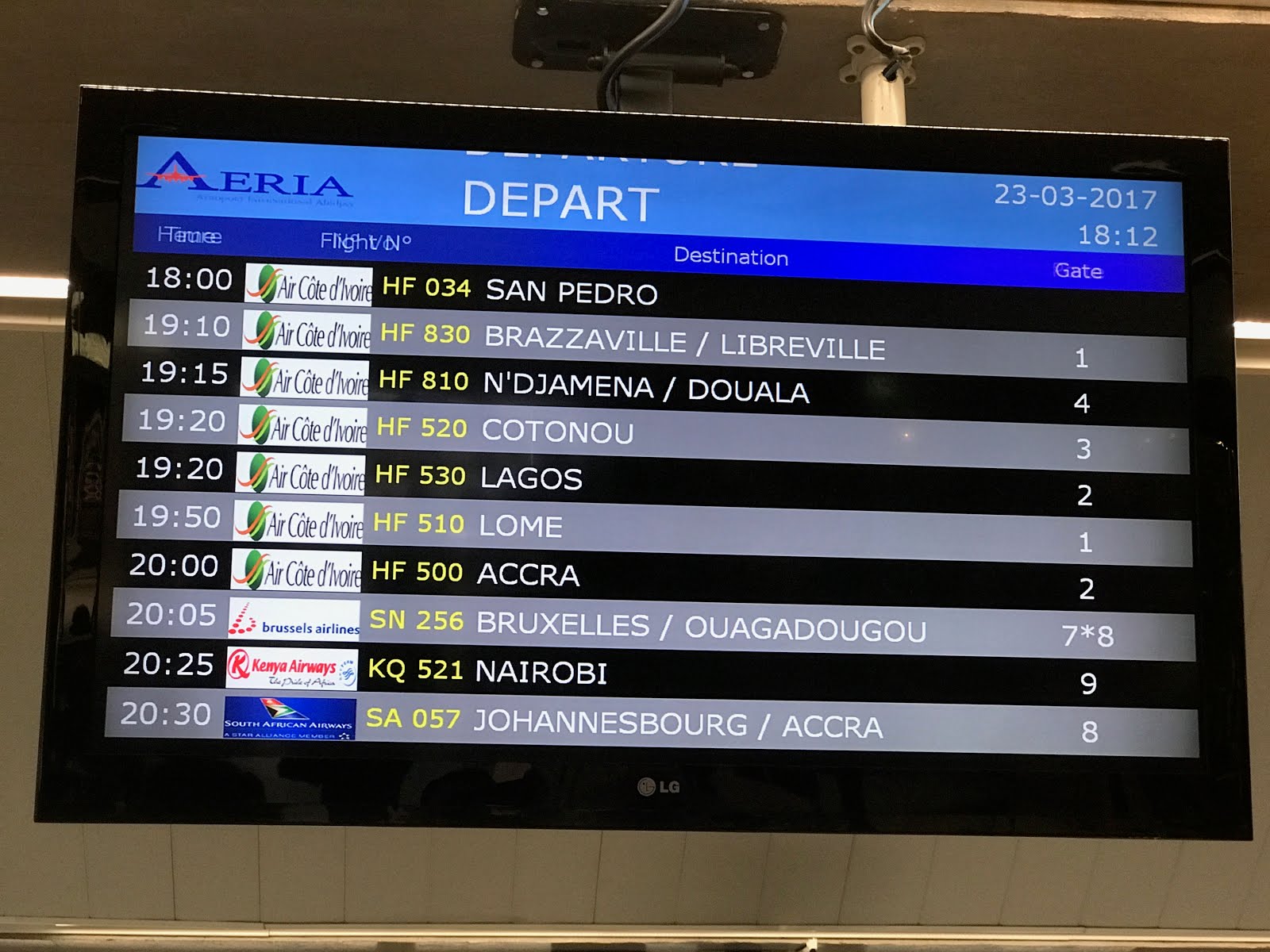
Abidjan: Evening Departures, 23 March 2017


Air Côte d'Ivoire naturally dominates the departures board at Abidjan's Felix Houphouët-Boigny International Airport, the airline's base and the principal gateway to the country. See we see an evening departures list for a 2-1/2 hour window from 18:00 to about 20:30—although the noon flight to Conakry has been massively delayed, it seems.

At the six o'clock hour, one of the airline's handful of domestic operations takes off with a flight to San Pedro, the cocoa port in the southwest of the country, near the Liberia border (first featured on the Timetablist with this post). The 7-8pm block features a half dozen of the airline's regional flights, starting with the longest haul of the HF schedule, to Libreville with onward service to Brazzaville. Fifteen minutes later the flight for Douala leaves, which then terminates at N'Djamena, Chad. Nearer routes take up the bottom of the hour: Cotonou, Lagos, and neighboring Accra and Lomé.


From 8 o'clock, the long-haul departures begin for other airlines. Here we see the flight on Brussels Airlines to Zavantem via Ouagadougou, and the non-stop to Nairobi. A little later, the Conakry flight had fallen off the board, and South African Airways SA057 to Johannesburg with a stop in Accra, appeared. 

Tuesday, April 4, 2017

Air Côte d'Ivoire: The Regional Network, March 2017


The other intersection of Air Afrique's complex politico-economic network was its base at Abidjan. After the demise of the pan-regional carrier in 2002, Côte d'Ivoire launched a succession of national carriers, first Air Ivoire and today Air Côte d'Ivoire.

Today—particularly with the sad degradation of Arik Air and other Nigerian attempts at a regional, trans-national carrier—this airline is perhaps the most important airline network in the region, stretching not only from Dakar to Douala, but also offering the rare handful of inter-languaphone connections across the English- and French-speaking postcolonial checkerboard of West Africa, with nonstops from Abidjan to Freetown, Monrovia, Accra, Lagos and even Abuja.

Like Air Afrique before it, and in a similar fashion to its only rival to regional dominance, the Ethiopian Airline's backed venture Asky, the Ivorian airline extends well into central Africa, with service to French-speaking Libreville and Brazzaville as well as its coastal oil city, Pointe-Noire, and even as far south as Kinshasa.

However, unlike Air Afrique and its immediate predecessor, Air Ivoire, Air Côte d'Ivoire has yet to launch any service outside of Africa, such as flights to Europe. Despite the volume of traffic between Abidjan and France, it is all taken up by Air France and other metropole companies. Air France/KLM Group's 20% stake in Air CIV likely explains the lack of intercontinental operations. 

Tuesday, January 31, 2017

Kenya Airways: Africa in Focus, March 2016


This route map showing Kenya Airways's vast operations across Africa can be seen as something of a key to the graphic in the advertisement shown in yesterday's post, although, strangely, Bangui itself has been left off the map. Routes span outward from Nairobi, naturally, although KQ continues to maintain something of a mini-hub in Accra to connect to Freetown and Monrovia, and Bamako is linked in with Dakar. There is likewise a set of interlinking routes in Southern Africa, connecting Lilongwe with Lusaka, Lusaka with Harare, and Harare with Livingston, at Victoria Falls.

Friday, January 27, 2017

Imperial Airways, 1937: The African Routes


As with its trans-Asian operations shown yesterday, the technology available to Imperial Airways in the early age of aviation necessitated a series of regular way stations for the royal charter's southerly system spanning Africa.

After the upper Nile, the line made its way to Khartoum, whence it splits, with one line turning to the west: Kano—Lagos—Accra and finally Takoradi, which only has domestic links today. There must have been pitstops in the drylands of French Central Africa but these are unnamed here; the paths of the green routes, connecting Algeria and Morocco to Niger and then the Congo, and reaching across to Madagascar, suggest French operations.

Continuing to follow the Nile south, the Cairo-to-Cape line stopped at Malakal, toady in South Sudan, then fanned across British East Africa in a complex web which appears to shown that one set of services remained inland along the Great Rift, passing through Nairobi on the way to Lusaka, Salisbury (today Harare) and Bulawayo in Rhodesia, and  then finally ending at Johannesburg. 

Another schedule reached the Swahili coast at Mombasa—Dar Es Salaam—(Ma)lindi and coastal Mozambique, with a bridge connection through Nyasaland at Blantyre, passing through Lourenço Marques (today Maputo) to terminate at Durban. The unlabeled green lines with the Union clearly suggest an early-stage South African Airways, reaching both Cape Town and Windhoek.