Showing posts with label Abidjan. Show all posts

Sunday, November 22, 2020

Air Liban to Europe and Africa, c.1952


 Prior to becoming Middle East Airlines, the flag carrier of Lebanon was known as Air Liban. Formed in 1945, it quickly expanded across Southwest Asia, Europe and into Africa as reflected in the destination list on this vintage brochure: Near East destinations include Aleppo and Baghdad, and fourth city is listed Jerusalem—a somewhat remarkable historical phenomenon, although this likely references the old Atarot Airport, at the time located in the Jordanian-annexed West Bank. Regardless, "Jerusalem" makes its Timetablist debut here. 

Further into the Gulf extends a spine of Jeddah—Dhahran—Doha—Kuwait; it is important to realize that, long before the rise of thee Gulf super-carriers, MEA/Air Liban was the primary airline of the Arab World, as its expansive name implies. 

Looking Westward, Air Liban ran its "swift Super DC-6C planes" to Nicosia, Ankara, Istanbul and to its only Western European capital, Paris, while send a second route to Cairo and Tripoli, with its most southernly service across the Red Sea to Khartoum, then spanning the vast Sahara to reach Kano, Lagos, Accra, Abidjan, and finally terminating at Dakar. This unusual number of West African destinations linked the Syrian-Lebanese commercial diaspora of coastal urban West Africa to their homeland. 

Sunday, November 24, 2019

British Caledonian Schedule, 1977


A few pages from the timetable of British Caledonian Airways in 1977, demonstrating the breadth of its reach at the height of its operations, reaching on its own metal to Banjul while codesharing extensively with Air Afrique, Air France, and UTA Overseas French Airlines to Abidjan, Abu Dhabi, Bangui, and Baghdad with other connections to Bangkok and Bahrain on other carriers such as Singapore, KLM, Qantas, Gulf Air, and Thai Airways. The flight to Barbados is a rare bit of history: IQ2/IQ4 was a Martinair Holland DC-10 flying for the old Caribbean Airlines. 
Interspersed vintage black-and-white sketches give a flavor of the High Classic Jet Age, while an in-page advert feature's the airlines cargo operations. 

Monday, January 1, 2018

Nigeria Airways: The Right Connections for Nigeria and West Africa, May 1979 (1 of 2)


Having now extensively reviewed the myriad airlines of contemporary and recent Nigeria, this New Year's Day we look back almost forty years to the era of the Winged Elephant, when the green-striped jets of Nigeria Airways ruled the skies.

Similar to previous features on The Timetablist, the national carrier was seeking the discerning eye of the Air Transport World reader in May, 1979, boasting of its "luxurious DC10," to "the nerve center of business in Africa," Lagos, but also throughout West Africa, as is helpfully shown in the route map at lower left.

What is today an aviation market arranged around the twin poles of Lagos and Abuja was, before Abuja was realized, organized between the southern hub of Lagos and the northern gateway of Kano, from whence intercontinental flights crossed the Sahara to European metropoles, including Rome and Amsterdam, but likewise eastward to the Middle East; the Kano—Jeddah link was recently revived but in those days the operation had the somewhat unusual final termination point of Karachi. A sort of code share, presumably on Egyptair, linked Cairo—Athens. Note also the cross-border link from Kano to Niamey, Niger. 

There was a second non-stop to London from Lagos, but mostly this was the start of the coastal routes along West Africa's edge, Cotonou—Lomé—Accra—Abidjan—Monrovia, where the widebody headed nonstop for New York JFK, while the smaller elements of the fleet linked Freetown—Banjul—Dakar and back in a minihub. There was a nonstop from Lagos to Douala, and also a connection to southeastern Calabar, as well as flights to Libreville and Nairobi. 

Wednesday, December 27, 2017

Med-View Airline: Lagos to Jeddah, November 2017


An enticing picture of the corniche of Jeddah glows from Med-View Airline's social media accounts a year on from the previous post. However, Med-View does not serve Jeddah directly from Lagos; instead the connection is Kaduna—Kano—Jeddah, resurrecting Kano's former role as the northern international gateway for all of Nigeria. 

Supplementally confusing is the city list at the bottom; while the destinations listed there are among those Med-View serves, several of them (Enugu, Ilorin, Owerri, and Port Harcourt) including many of the more ambitious (Baltimore, Houston, Johannesburg, Lisbon) are not served by the airline, and no plans have been announced. This, too, is reminiscent of earlier episodes in Nigeria's airline history. 

Friday, December 15, 2017

Air Peace: Lago-Accra Daily, February 2017


Accra has become established as perhaps the principal aviation cross-roads of West Africa, with the appearance of such unusual carriers as Cronos and CEIBA Intercontinental, as referenced in posts from earlier this month. Even more central to its position in the region is the importance of flights to Nigeria, most especially the critical Accra-Lagos air bridge, the busiest air corridor in all of West and Central Africa (although still minuscule in comparison to other famous shuttle routes such as São Paulo-Rio, Boston-New York-Washington, or Madrid-Barcelona, etc. 

The Timetablist has repeatedly featured the tragic circumstance of the short-lived Nigerian Air Carrier, be it the long-lost Nigeria Airways itself, or its series of successors, most famously in the last decade the Virgin Nigeria-Air Nigeria saga, which is now repeated with near-exact trajectory by the once-proud and now much-diminished Arik Air; it would be shocking if not so repetitive. 

In place of these companies now comes the latest and most-curious generation, which will be the subject of The Timetablist for the remainder of the month. These airlines are universally unusual and unreassuring in their appearance and appellation, all the moreso for their short lifespan. 

This particular transporter, named Air Peace, was established in 2013 and premiers in The Timetablist here for the first time. The company heightened its profile in February of this year by the introduction of a daily Lagos-Accra return schedule, performed by one the airline's various B737s—whether purchased or leased, the 733s and 735s are all of about 1997 vintage, which at least accords with the anachronistic paint scheme. 

Comfort is not further provided in this announcement, as while it is all well to feature the airline's other destinations, all domestic, the Coming Soon section surely invites only ridicule, or else Air Peace is on an expansion plan of historic efforts. Abidjan, Dakar, Douala and Niamey are reasonable achievable; London, Dubai, and Johannesburg certainly less-so, although Arik, and Virgin Nigeria in an earlier age, made similar plans. However, Atlanta, Mumbai, and the expansion simply referred to as 'China' seem to perhaps be more likely to require "more long wait."

Tuesday, December 12, 2017

CEIBA Intercontinental Routes, November 2015


Little Equatorial Guinea has not one but two airlines; the privately-formed Cronos, detailed in the previous posts, and the state carrier, CEIBA Intercontinental, which mimics its sister with a series of regional routes, including Accra, Lomé, and Douala, but interestingly, according to this map, avoiding Yaoundé and Lagos. The airline also extends further, reaching Abidjan and Dakar, as well as Pointe-Noire and Brazzaville in the Republic of Congo. 

 Undoubtedly the pride of CEIBA's services is the long-haul to Madrid. The sole long-haul operation flying the Equatoguinean flag reaches Barajas in the erstwhile colonial metropole thrice-weekly. As a carrier still banned by the European Union, with a B777 operated by Portuguese aviation company White Airways, complete with a 3-class configuration.

The other proximas routes shown here: Casablanca, Johannesburg, Las Palmas, Lisbon and Luanda, have never come to pass. 

Saturday, December 9, 2017

ASKY Route Network, June 2016


As mentioned in the previous post, the Accra-Monrovia sector was once the third-busiest route pair in West and Central Africa. Lomé-based ASKY Airlines for a time plied the corridor, for a time even acting as the sole carrier to Monrovia's secondary, inner-city airfield, Spriggs-Payne, but has since completely withdrawn from serving Liberia. 

The above route map, from mid-2016, shows Liberia and Sierra Leone as a gap in the carrier's extensive West African coverage, spinning out from Togo with a number of secondary links between regional capitals such as Niamey, Abuja, Libreville and Conakry in particular but also reaching under-served cities like Bangui and Bissau. 

Overlaid with ASKY's web are the bright green long-haul connections of parent company Ethiopian Airlines: to Addis Ababa, New York, and São Paulo. The Brazilian route, unfortunately, did not last (the airline switched the GRU non-stop to its Addis Ababa hub this year), but Ethiopian continues to invest in the ASKY project—and the Togolese government has responded with the opening of an enormous new terminal at Tokion in April of 2016. Since this time, Ethiopian has been able to sustain the transatlantic service to Newark, making tiny Lomé one of the just four West African airports with non-stop service to the United States. 

Tuesday, May 2, 2017

Tunisair Network, Early 2017


Tiny Tunisair is growing. Now extending to four continents, with extensive connections to metropolitan France (Bordeaux, Lyon, Marseille, Nice, Toulouse) as part of more than two-dozen European destinations, including third-level cities like Belgrade and Düsseldorf. 

The Western Africa network is not as extensive as other carriers, but Tunis is now connected to seven francophone sub-Saharan capitals, from Nouakchott to Niamey. Three routes to the Middle East are sustained: Beirut, Jeddah and Medina, which is misplaced on this otherwise straightforward graphic representation. Not every venture has met with success, as the airline's flights to Dubai were scrapped, as has been previously reported here. 

Pride of the carrier is the airline's most distant service: the year-old long-haul link to Montreal, Tunisair's first wide-body, trans-Atlantic operation. 

Friday, April 7, 2017

Abidjan: Evening Arrivals, 19 March 2017


Like the departures monitor shown in the last post, the evening arrivals schedule at Abidjan some weeks back was dominated by hometown carrier Air Côte d'Ivoire, with flights landing from Bamako, Niamey, Dakar, and Conakry in quick succession, followed an hour later by a domestic arrival from San Pedro.

As the time approached 7PM, the longer-range and intercontinental flights from foreign carriers began crowding the modest apron at Houphouët-Boigny International Airport: South African Airways from Johannesburg via Accra (which also stops at Kotoka International Airport on the return leg), then Air France from Paris an hour later. It is this flight, AF702, that is occasionally operated by an A380 superjumbo—one of the few to anywhere in Africa, and currently the only double-decker service between to francophone cities.

At 8:30, Rwandair's flight 222 from Kigali via Libreville and Douala, immediately followed by the Brussels Airlines link to Cotonou. The last arrival on the evening's board is the Tunisair non-stop from Tunis. 

Thursday, April 6, 2017

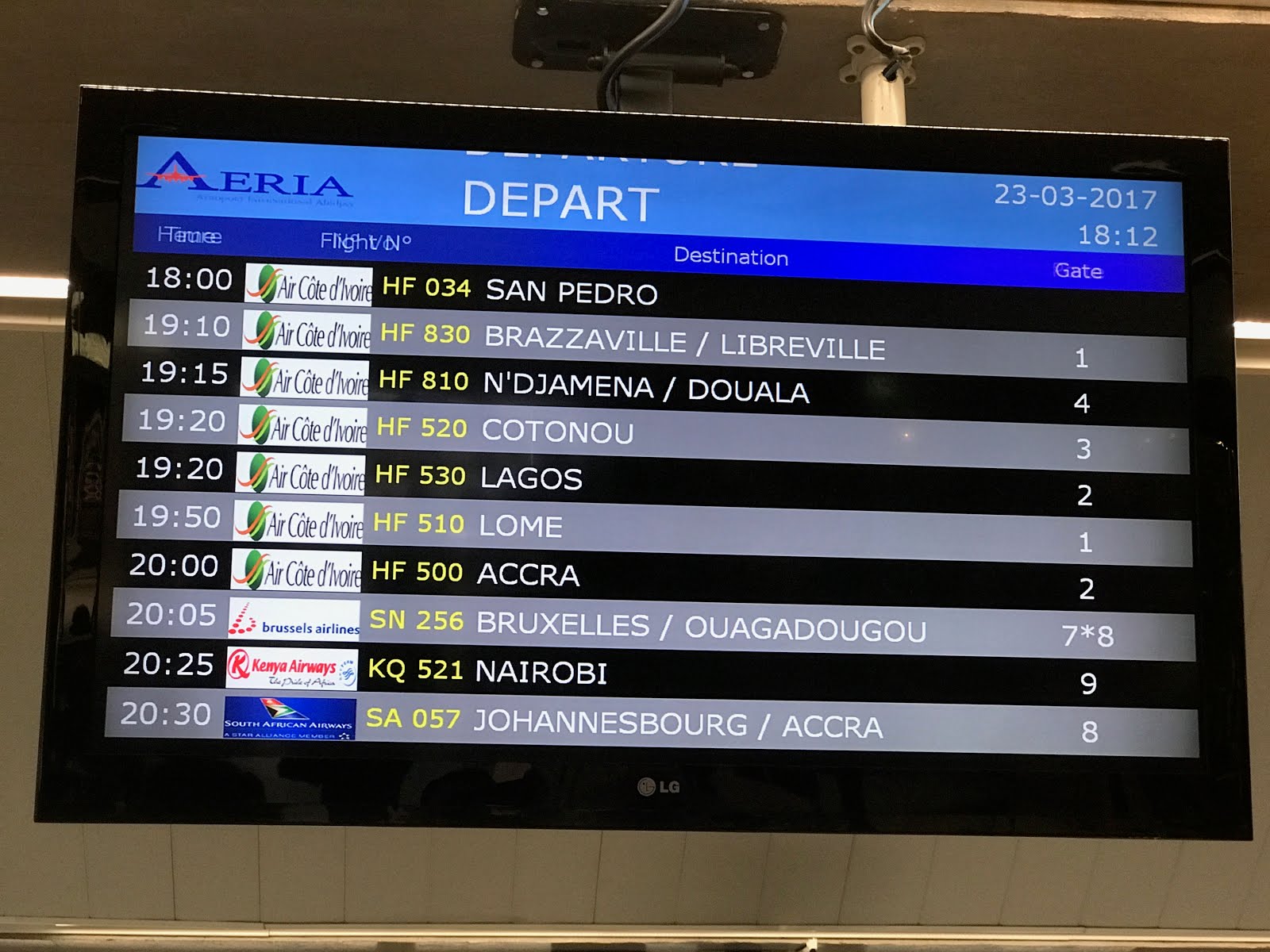
Abidjan: Evening Departures, 23 March 2017


Air Côte d'Ivoire naturally dominates the departures board at Abidjan's Felix Houphouët-Boigny International Airport, the airline's base and the principal gateway to the country. See we see an evening departures list for a 2-1/2 hour window from 18:00 to about 20:30—although the noon flight to Conakry has been massively delayed, it seems.

At the six o'clock hour, one of the airline's handful of domestic operations takes off with a flight to San Pedro, the cocoa port in the southwest of the country, near the Liberia border (first featured on the Timetablist with this post). The 7-8pm block features a half dozen of the airline's regional flights, starting with the longest haul of the HF schedule, to Libreville with onward service to Brazzaville. Fifteen minutes later the flight for Douala leaves, which then terminates at N'Djamena, Chad. Nearer routes take up the bottom of the hour: Cotonou, Lagos, and neighboring Accra and Lomé.


From 8 o'clock, the long-haul departures begin for other airlines. Here we see the flight on Brussels Airlines to Zavantem via Ouagadougou, and the non-stop to Nairobi. A little later, the Conakry flight had fallen off the board, and South African Airways SA057 to Johannesburg with a stop in Accra, appeared. 

Wednesday, April 5, 2017

Air Côte D'Ivoire: Twice Daily to Dakar from Abidjan, Spring 2017


As was the case with the ancient Air Afrique, Air Côte d'Ivoire's most frequent route is between the two major francophone cities of West Africa: it's base in Abidjan and the capital of Senegal, Dakar. The airline runs the route twice per day— that computes to 14 flights per week, as this billboard, one of many copies currently found across the Ivorian capital, helpfully explains.

Tuesday, April 4, 2017

Air Côte d'Ivoire: The Regional Network, March 2017


The other intersection of Air Afrique's complex politico-economic network was its base at Abidjan. After the demise of the pan-regional carrier in 2002, Côte d'Ivoire launched a succession of national carriers, first Air Ivoire and today Air Côte d'Ivoire.

Today—particularly with the sad degradation of Arik Air and other Nigerian attempts at a regional, trans-national carrier—this airline is perhaps the most important airline network in the region, stretching not only from Dakar to Douala, but also offering the rare handful of inter-languaphone connections across the English- and French-speaking postcolonial checkerboard of West Africa, with nonstops from Abidjan to Freetown, Monrovia, Accra, Lagos and even Abuja.

Like Air Afrique before it, and in a similar fashion to its only rival to regional dominance, the Ethiopian Airline's backed venture Asky, the Ivorian airline extends well into central Africa, with service to French-speaking Libreville and Brazzaville as well as its coastal oil city, Pointe-Noire, and even as far south as Kinshasa.

However, unlike Air Afrique and its immediate predecessor, Air Ivoire, Air Côte d'Ivoire has yet to launch any service outside of Africa, such as flights to Europe. Despite the volume of traffic between Abidjan and France, it is all taken up by Air France and other metropole companies. Air France/KLM Group's 20% stake in Air CIV likely explains the lack of intercontinental operations. 

Sunday, April 2, 2017

Senegal Airlines Route Network, 2015


The Timetablist celebrated the launch of Senegal Airlines in 2011, as it replaced the defunct Air Senegal and promised a bright future: well capitalized, with a new fleet, able to take advantage of Dakar's natural position at the far-western tip of the African continent.

Sadly, despite Senegal's continued stability and even growth, the airline lasted barely five years. This graphic, an unhelpfully small file size, is one of the few scraps of the airline's history that remains online. It shows the extent of the airline's ambition, although it is challenging to confirm what was realized: was there ever a secondary hub in Cotonou? Here is evidence that at least the Cotonou—Libreville operation existed. Was either Paris or Brussels ever served? Seems, definitely, no.

Saturday, April 1, 2017

Mauritania Airlines Network, March 2017


Coming off of Air Afrique Week, the Timetablist back-catalogue is overflowing with examples of the post-Air Afrique era in Francophone West Africa. 

Despite the ever-present turmoil of West Africa's airlines—the sad, sudden end of Air Mali in the throes of conflict, then the demise of Gambia Bird during the Ebola crisis, followed by the failure just last year of the once-promising Senegal Airlines venture, and most recently the alarming deterioration of Nigeria's premier carrier, Arik Air—somehow sparsely populated, isolated Mauritania has been able to keep its flag carrier, Mauritania Airlines International, in the skies. 

Based at Nouakchott's brand-new Outoumsy International Airport, the state carrier has a small fleet of late-model B737-700s linking to nearby capitals. The route map here, taking up a window of the airline's ticket office in the Plateau business district of Dakar recently, shows a farther reach, such as dedicated routes to Cotonou and Brazzaville, which have, curiously, been crossed out from the map, while Abidjan was crossed out, perhaps by mistake, and then scribbled back in. The routes are not necessarily reflective of actual operations as the Bamako and Conakry flights are normally linked via Dakar, for example. 

What remains on the map, although, is not a reality, is the route shown to Paris at the top of the dial, without a shape for France, only existed for about two years. Despite this inconsistency, Mauritania Airlines does reach the European Union by way of its Nouakchott—Nouadhibou—Las Palmas service, in the nearby Canary Islands. Zoueratt is shown as the only other domestic route of this "international" airline. 

Friday, March 31, 2017

Air Afrique Route Network, 1987 (2 of 2)


Following on from the previous post, this large-format map allows for a close examination of the regional network of Air Afrique. This network was both extensive and limited, paradoxically, in that it connected the capital cities of the ten member states with an impressive array of links, and yet at the same time served very few other cities in the region and no secondary cities within any country at all, except for the single example that proves the rule: Pointe-Noire, the seaside petrol port in the Congo Republic. But no Nouadhibou, for instance.

Outside of the major cities of its member-states, only Conakry and Lagos are served in Western Africa. Monrovia, Freetown, and Accra are bypassed. In Central Africa, the former member states of Cameroon and Gabon, which both subsequently set up their own national carriers, are still part of the system. Douala is connected to Bangui, Brazzaville, Cotonou, and Lagos—the latter a singular example of a non-member city connected with a non-member city. Even at this scale, it is unclear if the Douala—Cotonou route actually stopped in Malabo or this is just the confusion of the cartography. Likewise, Libreville is linked to Brazzaville, Lomé, and Lagos. No Yaoundé, however. 

A small detail that is easy to miss given the contours of the continental shelf is the Dakar—Las Palmas route. 

Thursday, March 30, 2017

Air Afrique: The Four Continent Route Map, 1987.


Fitting to end this year's Air Afrique Week with one of the most magnificent items of the airline's heritage that this blog has been able to feature: a 1987 route map, found recently on the wall of a travel agency in Dakar, Senegal. 

The Map is based on a popular wall map that was widely distributed in the 1980s, and although strikingly colorful it is not particularly faithful to terrain or topography. It is generally a poor decision to begin a route map from a conventional map, as generally the original cartographer has already displayed a surfeit of information which is extraneous to displaying the airline's route system. 

While that is especially true in this case, as a Mercator Projection version of this map is thoroughly critiqued on this cartography blog, in this case the trouble is greatly mitigated by the use of white route lines against the dark, natural palette of the oceans and continents. 

Being itself a wall-sized poster, this map is also large enough to visually convey the complex network of Air Afrique to the observer by its scale. Beyond the dense interlacing of its regional network (which will be more thoroughly examined in a separate, subsequent post) what is immediately evident are the long haul connections to other continents.

Chief among these are the many Trans-Saharan routes to France, especially the fountain shower emanating out of Paris: Bordeaux, Abidjan, Lome, Ouagadougou, Marseille, Lyon, Ouagadougou, Rome, N'Djamena, and Bangui. 

The interior connections to southernly French cities was surely a stop-over operation: Bamako is connected only to Lyon and Marseille, for instance. Likewise, follow the many lines to see how Niamey, was linked to all three secondary French cities, including, apparently, via Agadez (gateway to vast Areva uranium mine that fuels most of France's public power utility) but not directly to Paris non-stop. Interestingly, one of the other cities not directly connected to Paris is one of the airline's main hubs: Dakar, which seems to be linked only via Nouakchott. or one of several other European cities. 

These latter elements—Dakar to Bordeaux, Geneva, Rome, and Marseille— are separated out from the crowd by swinging in a dramatic, centripetal fashion westward, well over the North Atlantic. The only route to the west of this is reverse-S curve Dakar—New York service. As has been stated many times before during our Air Afrique weeks, as much prestige as the multiple routes to the metropole afforded, it was this lone transatlantic operation that was the flagship pride of the consortium. 

It is easy in this rendering to overlook the other bell of Air Afrique's dual-hub network: Abidjan, whose ribboning loops link it across the region and again to Lyon, Marseille, Geneva, Bordeaux and again to Paris itself. The last intercontinental element is eastward endeavor from Chad to Jeddah, a nod to the pilgrimage traffic of so many Sahelians. 

The following post will focus on the regional route network. 


Tuesday, March 28, 2017

Air Afrique, Boarding Pass from the Congo, 1961


Here is an artifact from early in the life of Air Afrique: an old-fashioned ticket and boarding pass from 1961. While the details of the flight are not shown, the departure tax stub <<redevance>> was issued by the A.S.E.C.N.A. ground agents in the Republic of the Congo, the southernmost member of the Air Afrique coalition—indicating that this was likely departing from either Brazzaville or Pointe-Noire. In those days, destinations were many, mostly neighboring Libreville, Douala, or perhaps N'Djamena or Bangui. The ticket jacket provides the address of the airline's headquarters in Abidjan—perhaps that was the ultimate destination of this itinerary. 

Monday, March 27, 2017

Air Afrique: The Transatlantic Schedule, May 1980


A playing-card style pocket guide to Air Afrique's flagship transatlantic schedule as of May 2, 1980, showing the times for RK49 and RK50 to and from New York-JFK, a once-weekly operation originating in Abidjan on Saturdays, and linking at the pan-regional carrier's other base at Dakar, via Robertsfield in Monrovia, Liberia. Below this, the table shows the services of RK518, which offers a convenient connection to Lome, Togo on a Caravelle. On the lower right, RK107 begins at Lagos on Friday evenings, and connects through Abidjan via Lome, which the notes appear to show uses the same DC-8 that reaches the Air France terminal at JFK the following morning.

Tuesday, January 31, 2017

Kenya Airways: Africa in Focus, March 2016


This route map showing Kenya Airways's vast operations across Africa can be seen as something of a key to the graphic in the advertisement shown in yesterday's post, although, strangely, Bangui itself has been left off the map. Routes span outward from Nairobi, naturally, although KQ continues to maintain something of a mini-hub in Accra to connect to Freetown and Monrovia, and Bamako is linked in with Dakar. There is likewise a set of interlinking routes in Southern Africa, connecting Lilongwe with Lusaka, Lusaka with Harare, and Harare with Livingston, at Victoria Falls.

Thursday, December 22, 2016

Emirates Route Map, August 2016: Africa


As impressive as Emirates airline's reach across Europe is, the megacarrier blankets Africa equally, from Dakar to Dar Es Salaam to Durban. Here, the airline links together several city pairs for operation efficiency. As noted earlier, service to Dakar began backtracking to Dubai via Bamako recently; Lusaka service terminates in Harare; Kano and Abuja are banded together, and flights to Accra shuttle to Abidjan and back before returning to the UAE.

For all the credit that Emirates is due in its dedication to the continent, it had relegated the last of its comparatively older A340s to its African routes before retirement.