Showing posts with label Air Cote D'Ivoire. Show all posts

Friday, April 7, 2017

Abidjan: Evening Arrivals, 19 March 2017


Like the departures monitor shown in the last post, the evening arrivals schedule at Abidjan some weeks back was dominated by hometown carrier Air Côte d'Ivoire, with flights landing from Bamako, Niamey, Dakar, and Conakry in quick succession, followed an hour later by a domestic arrival from San Pedro.

As the time approached 7PM, the longer-range and intercontinental flights from foreign carriers began crowding the modest apron at Houphouët-Boigny International Airport: South African Airways from Johannesburg via Accra (which also stops at Kotoka International Airport on the return leg), then Air France from Paris an hour later. It is this flight, AF702, that is occasionally operated by an A380 superjumbo—one of the few to anywhere in Africa, and currently the only double-decker service between to francophone cities.

At 8:30, Rwandair's flight 222 from Kigali via Libreville and Douala, immediately followed by the Brussels Airlines link to Cotonou. The last arrival on the evening's board is the Tunisair non-stop from Tunis

Thursday, April 6, 2017

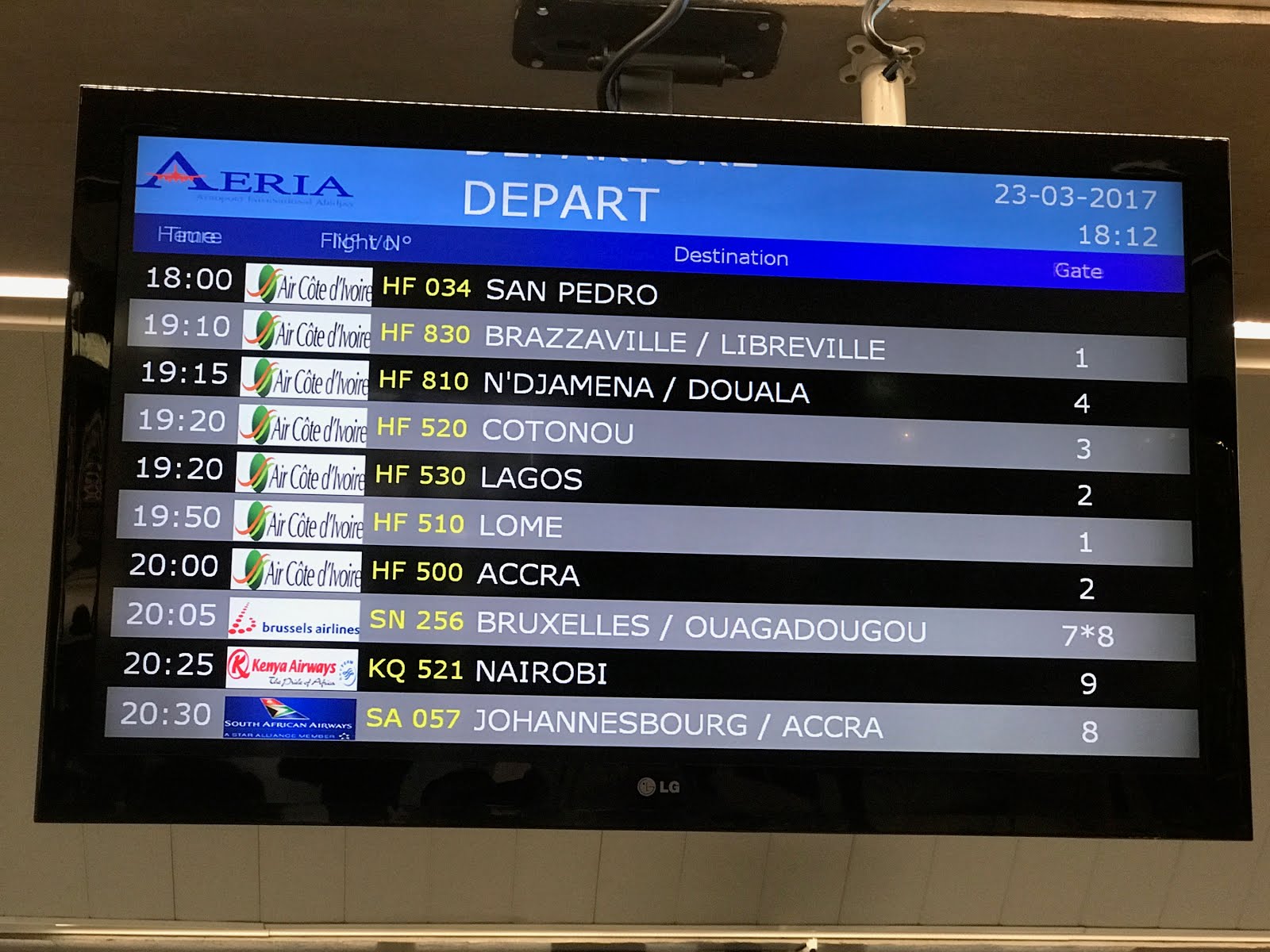
Abidjan: Evening Departures, 23 March 2017


Air Côte d'Ivoire naturally dominates the departures board at Abidjan's Felix Houphouët-Boigny International Airport, the airline's base and the principal gateway to the country. See we see an evening departures list for a 2-1/2 hour window from 18:00 to about 20:30—although the noon flight to Conakry has been massively delayed, it seems.

At the six o'clock hour, one of the airline's handful of domestic operations takes off with a flight to San Pedro, the cocoa port in the southwest of the country, near the Liberia border (first featured on the Timetablist with this post). The 7-8pm block features a half dozen of the airline's regional flights, starting with the longest haul of the HF schedule, to Libreville with onward service to Brazzaville. Fifteen minutes later the flight for Douala leaves, which then terminates at N'Djamena, Chad. Nearer routes take up the bottom of the hour: Cotonou, Lagos, and neighboring Accra and Lomé.


From 8 o'clock, the long-haul departures begin for other airlines. Here we see the flight on Brussels Airlines to Zavantem via Ouagadougou, and the non-stop to Nairobi. A little later, the Conakry flight had fallen off the board, and South African Airways SA057 to Johannesburg with a stop in Accra, appeared. 

Wednesday, April 5, 2017

Air Côte D'Ivoire: Twice Daily to Dakar from Abidjan, Spring 2017


As was the case with the ancient Air Afrique, Air Côte d'Ivoire's most frequent route is between the two major francophone cities of West Africa: it's base in Abidjan and the capital of Senegal, Dakar. The airline runs the route twice per day— that computes to 14 flights per week, as this billboard, one of many copies currently found across the Ivorian capital, helpfully explains.

Tuesday, April 4, 2017

Air Côte d'Ivoire: The Regional Network, March 2017


The other intersection of Air Afrique's complex politico-economic network was its base at Abidjan. After the demise of the pan-regional carrier in 2002, Côte d'Ivoire launched a succession of national carriers, first Air Ivoire and today Air Côte d'Ivoire.

Today—particularly with the sad degradation of Arik Air and other Nigerian attempts at a regional, trans-national carrier—this airline is perhaps the most important airline network in the region, stretching not only from Dakar to Douala, but also offering the rare handful of inter-languaphone connections across the English- and French-speaking postcolonial checkerboard of West Africa, with nonstops from Abidjan to Freetown, Monrovia, Accra, Lagos and even Abuja.

Like Air Afrique before it, and in a similar fashion to its only rival to regional dominance, the Ethiopian Airline's backed venture Asky, the Ivorian airline extends well into central Africa, with service to French-speaking Libreville and Brazzaville as well as its coastal oil city, Pointe-Noire, and even as far south as Kinshasa.

However, unlike Air Afrique and its immediate predecessor, Air Ivoire, Air Côte d'Ivoire has yet to launch any service outside of Africa, such as flights to Europe. Despite the volume of traffic between Abidjan and France, it is all taken up by Air France and other metropole companies. Air France/KLM Group's 20% stake in Air CIV likely explains the lack of intercontinental operations. 

Monday, May 27, 2013

Departures from Abidjan Port-Bouet Airport, 23 April 2013


The daily block of departures from Abidjan's Felix Houphouët-Boigny/Port Bouet International Airport on 23 April 2013 reveals a slate of recent developments in tropical African aviation. Especially new local entrant Air Côte D'Ivoire, recently risen from the ashes of the older Air Ivoire, providing three flights across the francophone region. Its first flight were in December 2012 and this post marks its first appearance on Timetablist.

Another is the young Senegal Airlines, similarly a quick replacement for defunct Air Senegal International, which in this case is heading eastward to other French-speaking centers in Togo and Cameroon. Lastly, Mauritania Airlines International, set up in 2010 to replace defunct Mauritania Airways (which was itself a second-try at the failed Air Mauritanie), is heading back to its capital, Nouakchott, via Bamako, Mali.

Regional growth carrier ASKY has two flights: to its hub at Lomé and to Conakry, while Air Burkina, one of the few West African airlines that has lasted more than a few years, links Burkina Faso's secondary city, Bobo Dioulasso.

Non-regional airlines make an appearance, providing the only links with non-French-speaking cities: Emirates offers the only wide-body on the day's schedule, its quad-engined A340s hopping next door to Accra before heading home to Dubai; Ethiopian Airlines ET916 is a next-gen B737 that stops in Cotonou before returning to its base at Addis Ababa's Bole Airport after a long journey from one side of the continent to the other.