Showing posts with label Lome. Show all posts

Saturday, January 6, 2018

KLM Route Network, 1982.


Zooming ahead several decades from yesterday's post, a circuit-board cartography shows the six-continent, circumnavigational system of KLM. Reminiscent of the powerful, dynamic abstractions of Lufthansa's famous spinnernetz Streckenatlas of the same era, the Royal Dutch route network is simplified into web of trunk routes, yielding only general information of the intercontinental connectivity performed by the carrier. Likewise, the continents are represented with mind-bending liberties; Alaska and South America in particular bearing only slight resemblance to their true shapes. The top portion of the literature shows four of KLM's ultramodern jetliners, especially the flagship B747-200Bs, DC-8s and DC-10s. 

It is always remarkable to look back at the route maps of European flag carriers in this era, when more African capitals were served than American cities. Like many of those state airlines of the early jet age, KLM linked Europe to South America via the western edge of Africa, with Casablanca, Tangiers, and Freetown linked together in a right angle which continues on to Monrovia, Accra, Lomé and Lagos, making a northward left at Kano. A single line shoots off of Morocco for Rio de Janeiro, São Paulo, Montevideo, Buenos Aires, ending at Santiago (nearly identical to Iberia's route shown in the previous post). Today, KLM still serves all of these Mercosur cities, except for Montevideo. 

An eastern route crosses the Mediterranean to Cairo, onward to Khartoum, with an elbow passing through NairobiKilimanjaroDar Es Salaam to end at Johannesburg. To this day KLM still flies to these three east African cities; indeed, KLM is the only European airline to fly to Kilimanjaro, but sadly and surprisingly, Cairo has been terminated, as was Khartoum. 


Monday, January 1, 2018

Nigeria Airways: The Right Connections for Nigeria and West Africa, May 1979 (1 of 2)


Having now extensively reviewed the myriad airlines of contemporary and recent Nigeria, this New Year's Day we look back almost forty years to the era of the Winged Elephant, when the green-striped jets of Nigeria Airways ruled the skies.

Similar to previous features on The Timetablist, the national carrier was seeking the discerning eye of the Air Transport World reader in May, 1979, boasting of its "luxurious DC10," to "the nerve center of business in Africa," Lagos, but also throughout West Africa, as is helpfully shown in the route map at lower left.

What is today an aviation market arranged around the twin poles of Lagos and Abuja was, before Abuja was realized, organized between the southern hub of Lagos and the northern gateway of Kano, from whence intercontinental flights crossed the Sahara to European metropoles, including Rome and Amsterdam, but likewise eastward to the Middle East; the Kano—Jeddah link was recently revived but in those days the operation had the somewhat unusual final termination point of Karachi. A sort of code share, presumably on Egyptair, linked Cairo—Athens. Note also the cross-border link from Kano to Niamey, Niger. 

There was a second non-stop to London from Lagos, but mostly this was the start of the coastal routes along West Africa's edge, CotonouLoméAccraAbidjanMonrovia, where the widebody headed nonstop for New York JFK, while the smaller elements of the fleet linked FreetownBanjulDakar and back in a minihub. There was a nonstop from Lagos to Douala, and also a connection to southeastern Calabar, as well as flights to Libreville and Nairobi. 

Tuesday, December 12, 2017

CEIBA Intercontinental Routes, November 2015


Little Equatorial Guinea has not one but two airlines; the privately-formed Cronos, detailed in the previous posts, and the state carrier, CEIBA Intercontinental, which mimics its sister with a series of regional routes, including Accra, Lomé, and Douala, but interestingly, according to this map, avoiding Yaoundé and Lagos. The airline also extends further, reaching Abidjan and Dakar, as well as Pointe-Noire and Brazzaville in the Republic of Congo. 

 Undoubtedly the pride of CEIBA's services is the long-haul to Madrid. The sole long-haul operation flying the Equatoguinean flag reaches Barajas in the erstwhile colonial metropole thrice-weekly. As a carrier still banned by the European Union, with a B777 operated by Portuguese aviation company White Airways, complete with a 3-class configuration.

The other proximas routes shown here: Casablanca, Johannesburg, Las Palmas, Lisbon and Luanda, have never come to pass. 

Saturday, December 9, 2017

ASKY Route Network, June 2016


As mentioned in the previous post, the Accra-Monrovia sector was once the third-busiest route pair in West and Central Africa. Lomé-based ASKY Airlines for a time plied the corridor, for a time even acting as the sole carrier to Monrovia's secondary, inner-city airfield, Spriggs-Payne, but has since completely withdrawn from serving Liberia. 

The above route map, from mid-2016, shows Liberia and Sierra Leone as a gap in the carrier's extensive West African coverage, spinning out from Togo with a number of secondary links between regional capitals such as Niamey, Abuja, Libreville and Conakry in particular but also reaching under-served cities like Bangui and Bissau

Overlaid with ASKY's web are the bright green long-haul connections of parent company Ethiopian Airlines: to Addis Ababa, New York, and São Paulo. The Brazilian route, unfortunately, did not last (the airline switched the GRU non-stop to its Addis Ababa hub this year), but Ethiopian continues to invest in the ASKY project—and the Togolese government has responded with the opening of an enormous new terminal at Tokion in April of 2016. Since this time, Ethiopian has been able to sustain the transatlantic service to Newark, making tiny Lomé one of the just four West African airports with non-stop service to the United States. 

Wednesday, May 10, 2017

Royal Air Maroc: the African Routes, 2011


Staying with RAM from the previous post, rare is the route map that doesn't label the cities, but here Royal Air Maroc makes for a fun guessing game—particularly challenging as the Moroccan state carrier serves so many African and European cities that identification is not so automatic. 

Looking at West and Central Africa, a single, curving route line seems to connect NouakchottBamakoOuagadougouNiamey, while there also seems to be a direct route to Bamako itself. There looks to be a link between CasablancaAbidjanPort Gentil. On the easternmost side, the service to Kinshasa appears to make a stop in Bangui. Accra, Lome, Cotonou and Lagos align smartly in the middle. 

Thursday, April 6, 2017

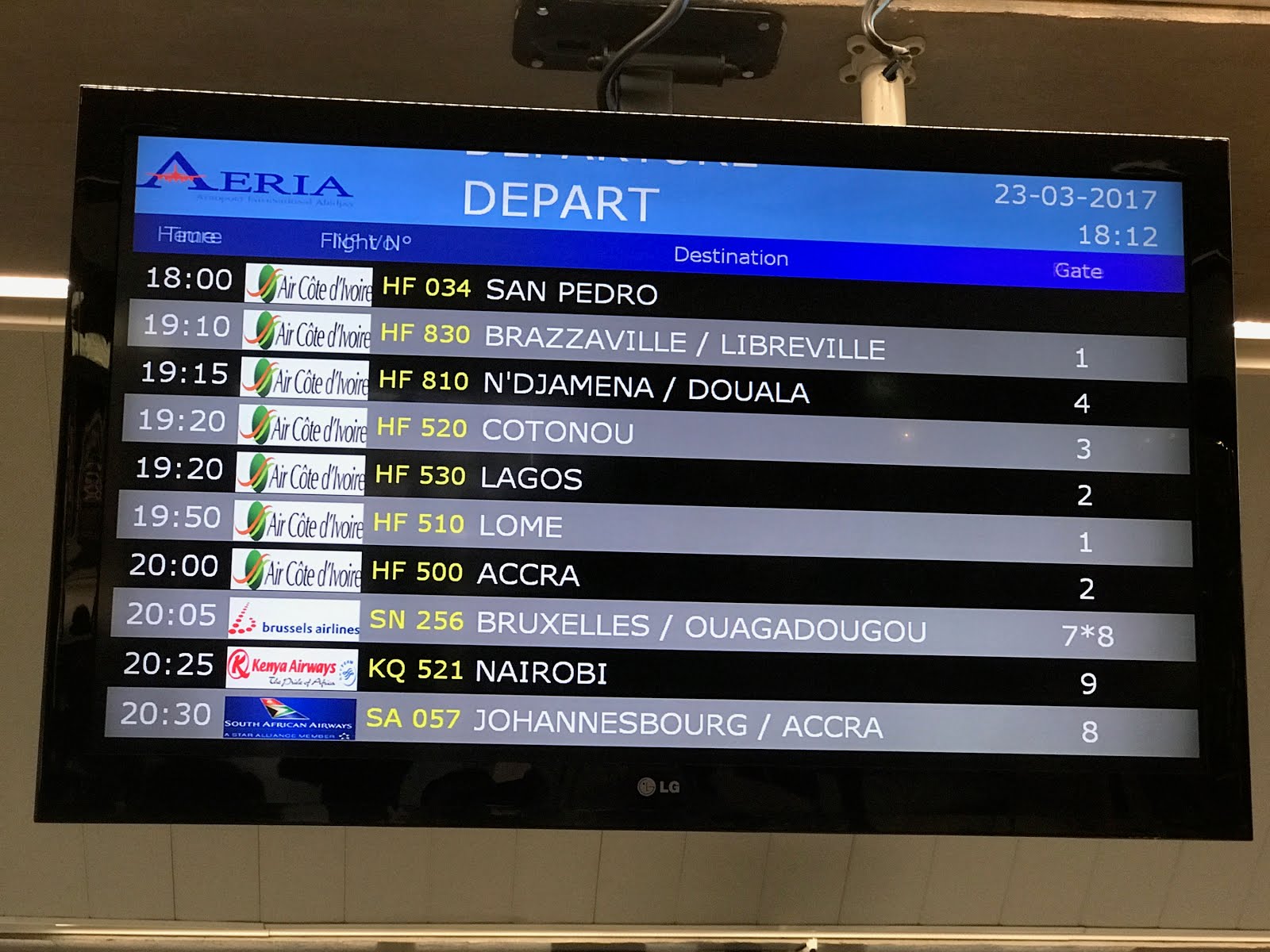
Abidjan: Evening Departures, 23 March 2017


Air Côte d'Ivoire naturally dominates the departures board at Abidjan's Felix Houphouët-Boigny International Airport, the airline's base and the principal gateway to the country. See we see an evening departures list for a 2-1/2 hour window from 18:00 to about 20:30—although the noon flight to Conakry has been massively delayed, it seems.

At the six o'clock hour, one of the airline's handful of domestic operations takes off with a flight to San Pedro, the cocoa port in the southwest of the country, near the Liberia border (first featured on the Timetablist with this post). The 7-8pm block features a half dozen of the airline's regional flights, starting with the longest haul of the HF schedule, to Libreville with onward service to Brazzaville. Fifteen minutes later the flight for Douala leaves, which then terminates at N'Djamena, Chad. Nearer routes take up the bottom of the hour: Cotonou, Lagos, and neighboring Accra and Lomé.


From 8 o'clock, the long-haul departures begin for other airlines. Here we see the flight on Brussels Airlines to Zavantem via Ouagadougou, and the non-stop to Nairobi. A little later, the Conakry flight had fallen off the board, and South African Airways SA057 to Johannesburg with a stop in Accra, appeared. 

Sunday, April 2, 2017

Senegal Airlines Route Network, 2015


The Timetablist celebrated the launch of Senegal Airlines in 2011, as it replaced the defunct Air Senegal and promised a bright future: well capitalized, with a new fleet, able to take advantage of Dakar's natural position at the far-western tip of the African continent.

Sadly, despite Senegal's continued stability and even growth, the airline lasted barely five years. This graphic, an unhelpfully small file size, is one of the few scraps of the airline's history that remains online. It shows the extent of the airline's ambition, although it is challenging to confirm what was realized: was there ever a secondary hub in Cotonou? Here is evidence that at least the Cotonou—Libreville operation existed. Was either Paris or Brussels ever served? Seems, definitely, no.

Friday, March 31, 2017

Air Afrique Route Network, 1987 (2 of 2)


Following on from the previous post, this large-format map allows for a close examination of the regional network of Air Afrique. This network was both extensive and limited, paradoxically, in that it connected the capital cities of the ten member states with an impressive array of links, and yet at the same time served very few other cities in the region and no secondary cities within any country at all, except for the single example that proves the rule: Pointe-Noire, the seaside petrol port in the Congo Republic. But no Nouadhibou, for instance.

Outside of the major cities of its member-states, only Conakry and Lagos are served in Western Africa. Monrovia, Freetown, and Accra are bypassed. In Central Africa, the former member states of Cameroon and Gabon, which both subsequently set up their own national carriers, are still part of the system. Douala is connected to Bangui, Brazzaville, Cotonou, and Lagos—the latter a singular example of a non-member city connected with a non-member city. Even at this scale, it is unclear if the Douala—Cotonou route actually stopped in Malabo or this is just the confusion of the cartography. Likewise, Libreville is linked to Brazzaville, Lomé, and Lagos. No Yaoundé, however. 

A small detail that is easy to miss given the contours of the continental shelf is the DakarLas Palmas route. 

Thursday, March 30, 2017

Air Afrique: The Four Continent Route Map, 1987.


Fitting to end this year's Air Afrique Week with one of the most magnificent items of the airline's heritage that this blog has been able to feature: a 1987 route map, found recently on the wall of a travel agency in Dakar, Senegal. 

The Map is based on a popular wall map that was widely distributed in the 1980s, and although strikingly colorful it is not particularly faithful to terrain or topography. It is generally a poor decision to begin a route map from a conventional map, as generally the original cartographer has already displayed a surfeit of information which is extraneous to displaying the airline's route system. 

While that is especially true in this case, as a Mercator Projection version of this map is thoroughly critiqued on this cartography blog, in this case the trouble is greatly mitigated by the use of white route lines against the dark, natural palette of the oceans and continents. 

Being itself a wall-sized poster, this map is also large enough to visually convey the complex network of Air Afrique to the observer by its scale. Beyond the dense interlacing of its regional network (which will be more thoroughly examined in a separate, subsequent post) what is immediately evident are the long haul connections to other continents.

Chief among these are the many Trans-Saharan routes to France, especially the fountain shower emanating out of Paris: Bordeaux, Abidjan, Lome, Ouagadougou, Marseille, Lyon, Ouagadougou, Rome, N'Djamena, and Bangui

The interior connections to southernly French cities was surely a stop-over operation: Bamako is connected only to Lyon and Marseille, for instance. Likewise, follow the many lines to see how Niamey, was linked to all three secondary French cities, including, apparently, via Agadez (gateway to vast Areva uranium mine that fuels most of France's public power utility) but not directly to Paris non-stop. Interestingly, one of the other cities not directly connected to Paris is one of the airline's main hubs: Dakar, which seems to be linked only via Nouakchott. or one of several other European cities. 

These latter elements—Dakar to Bordeaux, Geneva, Rome, and Marseille— are separated out from the crowd by swinging in a dramatic, centripetal fashion westward, well over the North Atlantic. The only route to the west of this is reverse-S curve Dakar—New York service. As has been stated many times before during our Air Afrique weeks, as much prestige as the multiple routes to the metropole afforded, it was this lone transatlantic operation that was the flagship pride of the consortium. 

It is easy in this rendering to overlook the other bell of Air Afrique's dual-hub network: Abidjan, whose ribboning loops link it across the region and again to Lyon, Marseille, Geneva, Bordeaux and again to Paris itself. The last intercontinental element is eastward endeavor from Chad to Jeddah, a nod to the pilgrimage traffic of so many Sahelians. 

The following post will focus on the regional route network. 


Monday, March 27, 2017

Air Afrique: The Transatlantic Schedule, May 1980


A playing-card style pocket guide to Air Afrique's flagship transatlantic schedule as of May 2, 1980, showing the times for RK49 and RK50 to and from New York-JFK, a once-weekly operation originating in Abidjan on Saturdays, and linking at the pan-regional carrier's other base at Dakar, via Robertsfield in Monrovia, Liberia. Below this, the table shows the services of RK518, which offers a convenient connection to Lome, Togo on a Caravelle. On the lower right, RK107 begins at Lagos on Friday evenings, and connects through Abidjan via Lome, which the notes appear to show uses the same DC-8 that reaches the Air France terminal at JFK the following morning.

Sunday, March 26, 2017

Air Afrique: Africa, Europe, and NYC, 1972


Its been a few years since the Timetablist has held an Air Afrique Week to celebrate one of the greatest carriers in African aviation history. To kick off, here is a glorious example from early in the airline's life; a unique, colorful route map that not only cleverly represents the young airline's complex route system in much clearer fashion than more conventional formats. 

To nitpick, it is perhaps slightly confusing just what city connects with what: is that a DakarBordeauxParis routing, or Dakar to Paris non-stop? Likewise, it's slightly unclear which schedules are shown between AbidjanLoméNiameyNiceGeneva

The home state cities are in red; European destinations in green; slight size bias is given to Paris. None of these discs are comparable to the megaplanet that is NYC, the fledgling flag-carriers flagship transatlantic service, whose connecting schedule is listed at left: KinshasaLibreville—Lomé—Cotonou, which connects to the mainline DC-8 RK50 for Abidjan—Monrovia—Dakar—New York.

Thursday, July 3, 2014

ASKY Airlines Network, March/April 2014 (Western Portion)


A continuation of the previous post, looking westward from Lomé, ASKY competes on the regular routes between Abidjan, Bamako, Ouagadougou, Dakar, and Conakry, while also offering stand-alone services such as the very rare Monrovia (Spriggs Payne)-Bissau service, which unfortunately was realigned to link to Conakry, one of a number of route realignments announced shortly after this issue of the magazine came out.

Speaking of Lusophone links, as with the previous post, the map disproportionately displays the distant destinations of mother-carrier Ethiopian Airlines, here advertising the relatively new Lomé-Rio de Janeiro/São Paulo services. Unfortunately, the Rio portion of this operation was unsuccessful, even in the midst of the World Cup and the imminent Olympics, Ethiopian dropped Galeão airport from its Brazilian service less than a month after this publication.

ASKY Airlines Network: March/April 2014 (Eastern portion)


A double-page spread at the back of ASKY Airlines' in-flight magazine from earlier this year: while the airline's primary hub is in Lomé and its strongest presence is across the west coast, the carrier is firmly established into the Congo basin, stretching as far south as Brazzaville, Pointe-Noire and Kinshasa. There is actually quite an operation out of Libreville, it seems, with links to Lagos and what is apparently the only connection to Yaoundé (in a now-typical network model; few ASKY destinations are linked to only one other city). 

The sole connection to Bangui appears to be Douala, which is partially plunged into the spine of the magazine, as is Abuja, which seems to connect up to N'Djamena, the airline's northeasternmost city, aside from the shamrock-green codeshare flight to the superhub of its parent company, Ethiopian: Addis Ababa appears on the map at upper right, somewhere in distant Chad, if the map were to scale. 

The next post features the western portion of the map. 

Monday, June 30, 2014

Air Gabon: External and Internal Networks, early- to mid-1980s


This is a partial repost of one the delightful gems that feature with astonishing regularity at our fellow airline timetable blog, Airline Memorabilia: An un-dated, un-specified brochure of Air Gabon, guessed at to be from the early 1980s, and corresponding well to other artifacts posted here in the past of the now-defunct Gabonese flag carrier. Surely the international network are usual suspects: Lomé, Cotonou, Abidjan, and Dakar, and even at its tiny scale the world map shows a clump of electrical cords plugged in from Libreville to Marseille, Nice, Geneva, and surely Paris, and probably Rome.

Gabon was so French that it even had its own Air Inter: Air Inter Gabon, which apparently operated the circuit board at right: a staggeringly numerous network of intereur destinations—there appear to be nearly 30 in the New England-sized nation. Unfortunately, due the resolution of the file, the exact list of cities can only be guessed at comparing a map of the country with the graphic. Even The Encyclopedia of African Airlines chronicles only a handful of them. Clearly the coastal petrol station of Port-Gentil is linked along the coast, and the other coastal cities are almost certainly Iguela and Tchibanga.

There is an evident triskelion of air routes converging at the extreme southeast of the forested country, which is surely the city of Franceville and barely but clearly the very nearby center of Moanda is also shown. While larger towns such as Lambaréné and northernmost Oyem are unquestionably shown here as well as Bitam, Koulamoutou, Makokou, Mayoumba, and Mouila, but there were at least a dozen others at the time. Only a higher-res graphic would shed light.

Thanks as always to the generosity of the first-rate Airline Memorabilia blog for uncovering and sharing this unique item. 

Saturday, June 21, 2014

Royal Air Maroc: The African destinations, 2011


Le Réseau Royal Air Maroc du Afrique shows the impressive extension of the airline's West and Central African operations as they stood in mid-2011. From Nouakchott to Niamey, Banjul to Brazzaville, Conakry to Kinshasa, RAM successfully bridges both the Anglophone and Francophone checkerboard of the region.

The map lacks route lines, which would be particularly helpful as many of these destinations are linked together before reaching the home airport at Casablanca (Freetown-Monrovia, for instance). Also, to connect with European and other intercontinental flights, many sub-Saharan cities are served at odd hours of the night—not the most convenient schedule, but for many of these cities, one of the few options out of town.

Monday, June 16, 2014

Afriqiyah Airways Network, 2011


A destination map of sorts, printed on the window shade of the Afriqiyah Airways ticket office, which now sits fading in the West African sun as the airline vacated in the office some time in 2011 due to its global grounding as a result of the Libyan revolution.

Previous to its sudden suspension, Afriqiyah was a surging force in trans-African transportation, connecting via its main hub at Tripoli to 14 West and Central African destinations as well as Johannesburg, transferring these intercontinental services to an array of European cities, from Düsseldorf to London, Paris, Amsterdam, Brussels, and Rome, as shown here, although the labels for each red dot are scattered, with Jeddah off the coast of Australia, Bangui near Antarctica, Ouagadougou and N'Djamena in the Indian Ocean, Khartoum at the Maldives, Abidjan near the Falklands, Kinshasa near Cape Town, Niamey near the Cape Verde Islands, Rome near Arkhangelsk, London north of Greenland.

Farther afield, Afriqiyah flew to a handful of Asian destinations: Jeddah and Dubai, predictably, somewhat randomly to Dhaka, Bangladesh, and distant Beijing.

Since the partial cessation of hostilities in still-volatile post-Qaddafi Libya, Afriqiyah has operated a diminished network, with services to Jeddah, Düsseldorf, London but not a single sub-Saharan city.

Saturday, March 15, 2014

Air Afrique: The Schedules from Paris and Pointe-Noire, 1990


Continuing from the previous post, the schedule from Air Afrique to and from Paris CDG rounds out, followed by the schedule from Pointe-Noire, the Republic of Congo's coastal petrol capital.

Non-stop fights from Charles de Gaulle reach N'Djamena, Nouakchott, Niamey and Ouagadougou, as well as Rome, interestingly, an intermediate stop of RK011 to Dakar, shown in the previous post. Domestic connections to Nouadhibou on Air Mauritanie and to Yamoussoukro on Air Ivoire are shown.

Flights from Brazzaville and Lomé link to Pointe-Noire, one of Air Afrique's southernmost destinations. The schedule helpfully provides links to European destinations such as Nice, Geneva, Marseille, London, Cologne, Frankfurt, Brussels and Bordeaux; three of the connections from Brazzaville’s Maya Maya International Airport are listed on the DeHavilland DHC-6, or the Fokker F-28 and F-27 metal of Lina Congo, the obscure domestic airline of the Republic of the Congo. All three national airlines mentioned here (along with Air Afrique itself, of course) are now defunct.

Special thanks to the wonderful website Airline Memorabilia for the original posting. 


Air Afrique: The schedule from Paris, 1990


Our second Air Afrique week continues, as does the cross-posting from Airline Memorabilia of the mid-1990 schedule from Air Afrique. This page rounds out the last of the Ouagadougou connections and starts the listings to and from Paris Charles de Gaulle, the premier destination for the multinational airline. Near-daily DC-10s departed from the primary hubs of Abidjan and Dakar (the schedule includes UTA DC-10s and B747s), while connections to Accra on Ghana Airways are shown below. UTA and Air Afrique also shared direct and on-stop connections from Bamako, Bangui, and Brazzaville.

Same-plan service as well as interline connections via the bigger gateways are shown for Cotonou and Lomé, while other airlines provide connections to Conakry, Lagos and Monrovia. Interestingly, service to secondary French cities such as Bordeaux and Marseille are shown as non-stops, meaning Air Afrique A300s and DC-10s landed in Southern France before reaching Roissy.

Friday, March 14, 2014

Air Afrique: The Schedule from New York, 1990

Continuing with Air Afrique week, and continuing with the pages of the airline's 1990 schedule first posted by Airline Memorabilia, the services to New York, the airline's only American destination. 


Air Afrique's twice-weekly DC-10 flights from Dakar to New York-JFK were the pride of it's network, even more so than the flights to metropolitan France. Here we see the full operation of both services, which originate in Abidjan on Wednesdays and Saturdays, both stopping at Dakar's Yoff Airport before crossing the Atlantic. Interestingly, the mid-week flight stops in Monrovia's Roberts International Airport; while the connection between Liberia and the U.S. is obvious, it was neither francophone nor a member of the Air Afrique consortium.

Aside from Abidjan/Dakar connections to Cotonou, Lomé, Bamako, Lagos and Niamey, the New York schedule suggests a number of connections not via Dakar, but on a trans-atlantic Air France B747 to CDG, which shows the various Air Afrique DC-10 flights to Brazzaville, Bangui, and N'Djamena. Intra-African links are also suggested on Ghana Airways to Accra and Air Gabon to Libreville.

Special thanks to the excellent Airline Memorabilia blog for allowing re-posting of this unique item.

Wednesday, March 12, 2014

Air Afrique: Schedule from Abidjan, 1990

The remainder of this Air Afrique Week will be devoted to reposting pages from the airline's timetable from mid-1990, which was originally posted by our friends at the Spanish-language Airline Memorabilia site.

Here is a page of the superhub schedule: flights out of Abidjan's Port Bouet Airport, the airline's busiest operating base. Non-stop flights within the consortium's network include a litany of A-300 flights to nearby Lomé and Niamey and two-stop service to Douala and Libreville, while other flights in West Africa include a single non-stop DC-10 flight to Lagos and Monrovia, once per week, which, although just next door, are as frequent as the DC-10 services to Geneva, Lyon and Marseille. The pride-of-network, twice weekly trans-Atlantic flights to New York-JFK are at right. Milan, Munich, Manchester, MoscowLondon and Montreal are also shown, along with other connecting services to as nearby as N'Djamena and as distant as Los Angeles.