Monday, October 31, 2011

Service from Malta to Tunis and Tripoli, Summer 2011

Malta, the European Union's smallest member, is a tiny rocky archipelago in the center of the Mediterranean below Sicily. It is actually more southernly than the coast of North Africa, and acts as a European gateway to Libya especially.

Shown here on the Malta International Airport's summer 2011 timetable are weekly services to Tripoli, with an identical flight every day by Libyan Arab Airlines complimented by an array of daily flights from Air Malta, with a twice weekly connection on JAT which goes onward to Belgrade.

Above are four weekly services to Tunis, direct and also via Monastir on Servisair. All these operations increase during the summer months, as seen from the matrix at far right.

Sunday, October 30, 2011

Various International Destinations from Frankfurt, Summer 2011


Excerpts from the Summer 2011 Timetable published by Frankfurt International Airport, showing Lufthansa's multiweekly nonstops to sub-Saharan Africa, such as Abuja, Accra, Addis Ababa, Lagos, Libreville, and Luanda; as well as Ethiopian's 5-times weekly to Addis and Air Namibia's all-but-Wednesday nonstop to Windhoek; Condor Flugdienst's once-weekly scheduled charters to Arusha, Tanzania's Kilimanjaro International and Agadir in Morocco; Sun Express and Turkish Airlines leisure flights to Adana; Lufthansa and Croatia Airlines flights to Zagreb, and Air Berlin's Friday flight to Zakynthos in Greece.

Saturday, October 29, 2011

Royal Jordanian: Non-stop from Munich to Amman 3x Weekly, Summer 2011

A delightful Jordanian flight attendant stands at the entrance not of a jet aircraft but the cliff opening of Petra, in a German and Arabic print advert marketing Royal Jordanian's thrice-weekly service from Munich to Amman, with connections to the Middle East and Asia.

Friday, October 28, 2011

RusLine: Non-stop from Munich to Volgograd, 2011

As with yesterday's post on Yakutia, Munich Airport sees seasonal service from several of Russia's second-tier carriers. RusLine links the Bavarian Imperial capital with the stately riverside metropolis of Volgograd. This is Volgograd's only link to the mainland European Union, and RusLine's only destination in Germany, although the airline also serves Istanbul, Dubai, Larnaca, Beijing, Harbin, Ürumqi, Amman, and a large number of destinations across the Commonwealth of Independent States, from Kiev to Minsk, Baku to Almaty-- all with a small squadron of Canadair regional jets.

Thursday, October 27, 2011

Yakutia Air Company: Munich to Irkutsk non-stop, 2011

Twice weekly to the natural paradise on Lake Baikal, boasts this rather straightforward notice from the Munich Airport summer timetable. Russia is one of Germany's most important trading partners, but it is still interesting to see such low-profile Russian carriers such as Yakutia Air Company linking Bavaria and Siberia. The service is seasonal.

Yakutia's primary base at Yakutsk links the Sakha Republic with Seoul, Harbin, Qingdao; from the Irkutsk Oblast in serves Dushanbe and Tashkent. The airline also has a seasonal presence at Prague, Barcelona, Larnaca, Rimini, Trieste, Dresden and Hanover.

Wednesday, October 26, 2011

All Nippon Airways: Daily Direct Overnight from Munich to Tokyo, Summer 2011

All Nippon Airways has always had a rather conservative international reach, flying to only six North American cities, and currently four in Europe. Some European cities like Milan, Rome, and Vienna were launched and withdrawn. This German advert shows how ANA uses Munich's airport as a gateway from Tokyo to a number of EU cities (via its Star Alliance sister, Lufthansa).

Curiously, one might imagine that this marketing would be better suited to the Japanese passenger to Prague, Lyon or Bologna, but here it seeks to demonstrate to Europeans how easy it is to connect from all corners of the continent to the daily overnight flight to Narita: barely-visible blue landmasses of Germany and Japan are linked with a white arrow, but a yet-to-be-used B787 points westward.

Tuesday, October 25, 2011

Lufthansa: New Flights from Munich, Summer 2011

Munich is one of Lufthansa's two "fortress hubs." Although much smaller than the massive megahub at Frankfurt, Munich Airport is important for both Lufthansa's links between North America, Asia and Europe on its own craft and with its Star Alliance partners, as well as origin-and-destination traffic serving the large multinationals in southern Germany, and the leisure needs of their well-off employees.

This is reflected in Lufthansa's summer announcement of new services from Munich: link Zadar and Dubrovnik in Croatia will ferry holidaymakers to the rocky resorts of the Dalmatian Coast, whereas a widebody such as the A340 shown will connect to the South American Star Alliance superhub of Sao Paulo-Guarlhos.

Monday, October 24, 2011

The Intercontinental Destinations from Munich, Summer 2011: Western Hemisphere


Despite the increasing presence of exotic global carriers and the extensive reach of the Star Alliance, Munich remains a primary gateway into Central Europe from North American cities. Air Canada, United Airlines, USAirways, and Delta all fly to Munich, but Lufthansa is the primary carrier across the Atlantic to the Alps.

Sunday, October 23, 2011

Intercontinental Destinations from Munich, Summer 2011: Eastern Hemisphere


A detail of the righthand side of the previous post. Although still primarily a landing point for the Transatlantic bridge into the heart of Europe, technology- and business-dense Munich has a large number of Asian services, especially among Lufthansa and its Star Alliance partners: All Nippon, Air China, Singapore Airlines, Thai Airways, and South African Airways all join up with United, USAirways and Air Canada at Munich.

Elsewhere, the close links between Russia and Germany are manifested in a handful of ad hoc Siberian cities.

Saturday, October 22, 2011

Intercontinental Destinations from Munich, Summer 2011

Munich's gorgeous and efficient airport may not be a first-tier European gateway, nonetheless its status as a Lufthansa "fortress hub," second only to Frankfurt, and the presence of a number of international airlines, provides Bavaria connections with five continents, with an increasing list of global carriers from the Middle East, Russia, and East Asia adding to the scope of Munich's reach. The Eastern portion of this map will be detailed in the next post.

Wealthy Bavaria is also linked directly with several leisure destinations, including the Maldives and Mombasa, and the Namibian capital, Windhoek, which to this day retains one of the largest German-speaking communities in Africa.

Wednesday, October 19, 2011

Kenya Airways: The Central & West African destinations, mid-2010

This detail from the previous post shows Kenya's 13 current and 5 future Central & West African destinations, as of July 2010. All proposed routes: Bangui, Brazzaville, Kisangani, Libreville, and Ndola, have been launched as of the date of this post. The addition of dedicated routes to Brazzaville and Ndola, when nearby Kinshasa and Lubumbashi are already served, added to the addition of such secondary destinations as Bangui and Kisangani, show the thickening of Kenya's coverage and the dominance of the airline across the entire continent. The convergence of the route lines on the right-hand side of this detail indicate the vortex of Jomo Kenyatta International Airport at Nairobi.

Like Delta Air Lines, its Skyteam alliance partner, Kenya has established something of a regional mini-hub at Accra Kotoka, with routes connecting to Abidjan, Freetown and Monrovia-Robertsfield.

The route lines are a bit confusing: Accra-Nairobi flights do not stop in Douala (but the flight to Douala does connect at Bangui), the Abidjan route did not land in Malabo.

Kenya Airways: The African Network, mid-2010


Kenya Airways' rapid expansion across its home continent is evident in the great breadth and depth of this route map, especially in comparison with the same article from just a year previous.

Kenya is still predominant across its home region, connecting neighboring East African cities, but with a large number of southbound routes, including a new link to Gaborone, Botswana.

Although not the focus of this and the following post, redlines reaching the page's edges show links to Europe and Asia. The three European destinations are suggested to be above the top of the page, although both Amsterdam and Paris are located on the visible portion of Europe.


Monday, October 17, 2011

Amsterdam Schiphol: Arrivals Board at 15:30, July 2011

A busy evening at one of Europe's superhubs. The fifteen minutes from 6:30pm commences with two of KLM's non-stops from China, one from Sichuan's capital at Chengdu and one from coastal Xiamen. Over the next five minutes, a flock of flights arrives from the corners of Europe: Easyjet from Prague, Alitalia from Milan, and Lufthansa from Munich. A Transavia flight from Lisbon is followed by an airBaltic Riga arrival.

At 40 minutes past the hour, another of KLM's increasing services to East Asia, this a link to its SkyTeam Partner Korean Air's megahub at Incheon, lands concurrently with more regional, low-cost services from Spain and Britain: An Arkefly charter from Mahon, Easyjet from Gatwick and BMI Baby from Nottingham. At quarter til 7, two Air France/KLM code shares get in from Bergen and Berlin.

This brief quarter hour demonstrates the breadth and diversity of Schiphol's connections.

Saturday, October 15, 2011

Delta Air Lines: The African Routes, Summer 2011

It is quite revealing to juxtapose this map with its iteration from two years previous. Delta's expansion into Africa has been an unquestioned success, even if some of its plans for linking the continent have not come to pass.

Aside from the long transatlantic lines coming across the page from Atlanta and JFK, what may be most striking is the appearance of a minihub at Accra's Kotoka, with services to both American gateways, as well as onward flights to Monrovia and Abuja (indirect service to the capital via Ghana surely stings many proud Nigerians; whereas most Liberians are merely thrilled to have the US carrier at all--and revel in its recent announcement of a third weekly Atlanta connection). A third spin-off is optimistically drawn to connect Malabo, the tiny capital of the tiny, and hugely wealthy, oil-rich state of Equatorial Guinea.

Absent is the erstwhile Cape Town service, and there is no mention of Sal in Cape Verde (itself originally conceived as a minihub), nor any onward services to Nairobi and Luanda, the latter entirely excluded from the map. Johannesburg is reached by a long stretch from Atlanta, by-passing the earlier way station at Dakar-Yoff.

The Arab Spring left Cairo off Delta's system for the summer; the airline's only Middle East destination is currently Dubai, besides its connections to Ben Gurion. Amman was tried and dropped. India is still reached from Amsterdam, a legacy of the Northwest Airlines partnership with KLM.

Sunday, October 9, 2011

Oman Air: Worldwide Network, 2011: Detail #2: The Subcontinent

Oman Air is in all ways a smaller iteration of the Gulf's burgeoning supercarriers. This similarity includes an expansive array of destinations in its South Asian backyard. With far fewer seat-miles to the Subcontinent than its rivals, Oman Air nonetheless offers more than 15 destinations out of Muscat, catering especially to foreign contract workers and shopping trippers.

Please see the two previous posts for more about Oman Air's current network, worldwide and in the Middle East.

Saturday, October 8, 2011

Oman Air: Worldwide Network, 2011. Detail #1: Middle East


Continued from the previous post: Omar Air in its home region. Even prior to its 2009 intercontinental expansion, Oman Air's network covered a number of cities in the Gulf and Arabian Peninsula.

Friday, October 7, 2011

Oman Air: Worldwide Network, 2011.


What had been a small, regional start-up from one of the last members of the original Gulf Air consortium has, since a total transformation in 2009, become a rival in service and reach to the great supercarriers of the Gulf. The makeover was marked by a logographic move away from the flag-motif livery to a still-distinctive but less heraldic blue, white and gold scheme.

While not nearly as global as the six-continent networks of Emirates, Etihad, or Qatar Airways, the map and image above show Oman's A330s reaching as far as London and Bangkok ,with staggeringly luxurious cabins. The next two posts will index the carrier's growing Middle East and Subcontinental networks of the above map.

Thursday, October 6, 2011

Zambian Airways: Domestic and Regional Routes, c.2008

Via this website, showing the full-extent of the now-defunct Zambian Airways, around the height of its operation in perhaps 2008. Regional operations, apparently with two decrepit B737-200s, reached as far as Harare, Lilongwe, and Lubumbashi from Lusaka, and operated a second base at the center of the copperbelt, Ndola.

This airline is unrelated to the much older, larger, but equally moribund Zambia Airways, which used to stretch from New York to Bombay, with dozens of destinations in between.

Although descendant of an aviation enterprise stretching back to 1948, the formally-named Zambian Airway's reach and lifetime was much more limited. Having come in to the national name in 1998, in the wake of Zambia Airway's 1994 collapse, Zambian Airways itself suspended service in January 2009, which led to the government filing suit against the airline the following month. Zambia today is without a state carrier, although the privately-held Zambezi Airways reportedly covers southern Africa from Lusaka.

Wednesday, October 5, 2011

Zambia Airways: A Warm Welcome At Heathrow, c.1980

A colorless advert is a bit of a cold way to boast of a warm welcome, and isn't best to convey the exotic colors of southern Africa. In fact, this 1980s advertisement (the models' clothing suggests that the decade had just turned) gives minimal indication of the adventuresome destination that it purports to promote.

Rather than talk wildlife or people, the bland subject at hand is ease of check-in, which is hardly a selling point for leisure travelers picking a safari stop. And while this topic and the lack of color on the print is dull enough, it is the lack of pigment in the models which is all the more displeasing. While this ad may be directed at British tourists, its strange that even the counter clerk seems not to be of African descent. On the whole, the atmosphere of the page would make one think of the drudgery of Victoria Station, not the glory of Victoria Falls.

Tuesday, October 4, 2011

Saudia: The International Route Map, 1983. Detail of Europe and North Africa

A detail from the previous post, showing the 1982/1983 route map of Saudia from the memorabilia collection of Flickr user Caribb. The airline's concentration on European and North African routes remains strong today, even if such cities as Athens have since been dropped, and Amsterdam relegated to a cargo-only flight. The printing of the dots for cities is slightly off.

Special thanks again to Flickr user caribb for the Creative Commons license.

Saudia: The International Route Map, 1983

A previously unfeatured item from the incredible memorabilia collection of Flickr user caribb. Saudi Arabian green colors all this map's continents, of which Saudia had reached four as of the end of 1982 and the beginning of 1983, the period for which this map was created. Dhahran, Jeddah and Riyadh were the main hubs, as they are today.

Saudia's deafening L-1011s and jumbo B747s reached from Manila to New York. Saudia, which was rebranded Saudi Arabian Airlines in the late 1990s, still serves Kano and Khartoum, but is absent from Mogadishu-- an unusual destination even then. Addis Ababa, Johannesburg, Kuala Lumpur, Washington, Hong Kong and Guangzhou are some of the destinations added since then. (the next post will detail the European destinations).

Special thanks to Flickr user caribb for the create commons license to repost.

Monday, October 3, 2011

Saudia: Eastbound Intercontinental Schedule, October 1969


The airline of Saudi Arabia was still diminutive in 1969, but already had a presence on a prestigious passage: London to Bombay, via the Kingdom.

On Sundays, a Saudia B707 left Heathrow and stopped in Frankfurt. From whence it flew directly to Dhahran, finally arriving early Monday in Riyadh. That same Monday, a second Saudia B707 left London and arrived after 1AM on Tuesday in Jeddah. The Frankfurt-Geneva-Jeddah axis was covered on Thursdays. A BOAC plied London to Jeddah direct on a roaring VC-10. On Mondays and Fridays, jets left Jeddah for Karachi and Bombay, stopping at Riyadh and Dhahran.

Tickets could be purchased at any BOAC or TWA office worldwide.

Sunday, October 2, 2011

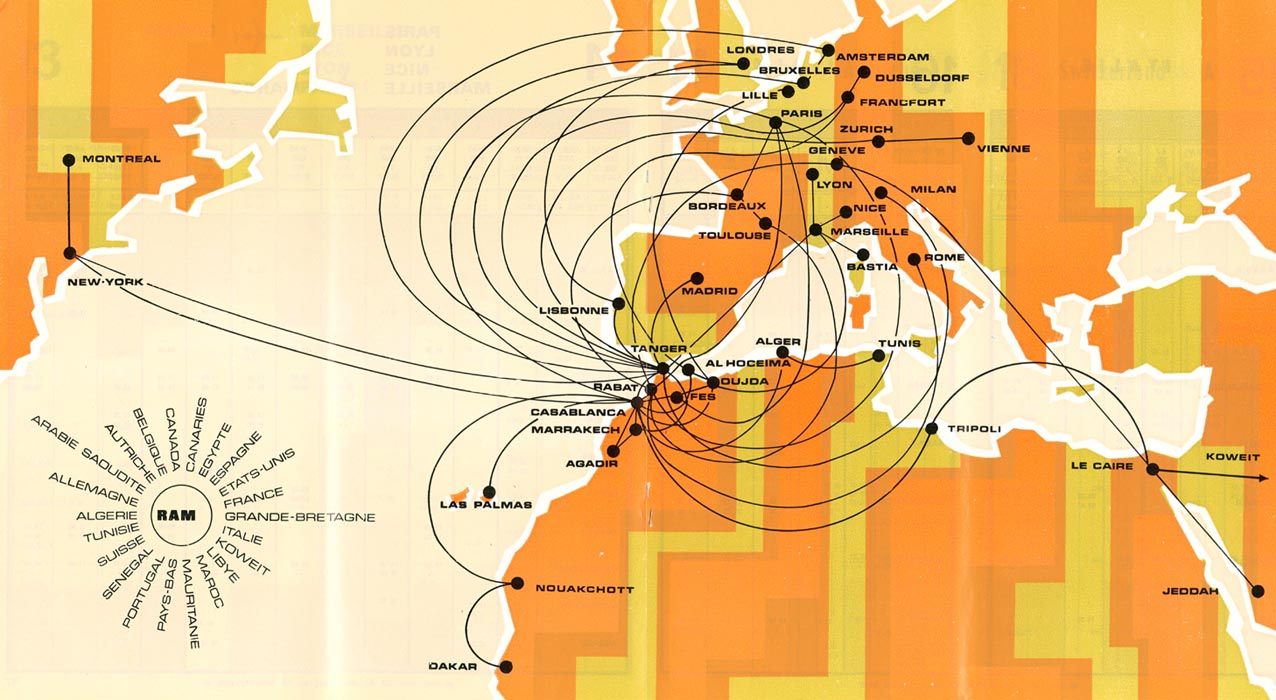
Royal Air Maroc: Systemwide Route Map, April 1976


An astonishing vintage route map, a gem of the tremendous collection of the website Timetable Images. Its issue date of April 1976 could be guessed at from the styling alone: a shag-carpet, VW-bus interior striping of the continents that follows neither national boundaries nor time zones, but zigzags to its own groovy pattern. The coastlines of the landmass are geometrically simplified, squared-off while still showing smaller juts such as Crimea and Crete, Cornwall and Cape Cod.

This quadrangularity contrasts to the jet-black route lines. Frictionless, looping ribbons convex proudly from their true navigational path, making for easy reading on the map. Northern European Routes are pulled far out into the Atlantic; Southern European lines ply semicircles over the Sahara. Tripoli and Le Caire are linked by a fanciful arc which touches mainland Greece; Nouakchott, due north of Dakar, is connected to the Senegalese capital by a wide "C" shape.

The labels are in quintessential Microgramma typeface, both on the map and at what stands in for a legend: the spiraling emblem at the bottom left, featuring the Francophone names of the nations which Royal Air Maroc serves. Such a badge seems to be an award to mark this fantastic réseau as a classic achievement of route map graphics.

All this can be admired before even considering the routes themselves, of which there are several treasures: Lille is the sixth metropolitain city served; JFK is reached from both Casablanca and Tangier, before swooping north to terminate at Mirabel; the airline stretches as far east as Koweit.

As can be seen from previous posts, RAM has expanded rapidly across Africa in recent years, but it seems to have yet matched the graphic achievements of amazing cartograph.

Saturday, October 1, 2011

Air Algérie: The African Destinations, August 2011

Fast-growing, gas-fueled Algeria's spreads it influence in West Africa with flights across the Francophone Sahelian and Sub-saharan region run its state airline, Air Algérie. The destinations, if not the routings, are shown here in a shot from the airline's sleek website.

Note the spelling of Bamako ("Bamaco"), as well as the blue-dot in the middle of the desert, Tamanrasset. Despite being the country's great trans-Saharan way station, Tamanrasset's airport does not seem to have any southbound scheduled services, although more than one airline links it to Paris-Orly.

Sunday, September 25, 2011

South African Airways: Re-introduction of Johannesburg-Kinshasa service, 1994

Although two years after the issuance of the envelope in the previous post, this item still sports the apartheid-era Nassau Orange and Navy color scheme, and uses only South Africa's European languages. Sent in the same year as the election of Nelson Mandela, the purpose of this envelope was instead to celebrate the reappearance of South African flights on the continent of Africa itself, much of which had been off-limits due to anti-apartheid sanctions.

Although the service to Zaïre was the focus of this cover, the better part of the paper is taken up with a full, worldwide route map, showing SAA/SAL's trans-Indian services from Mauritius to Perth and Sydney, as well as Hong Kong and Taipei; a fascinating Rio de Janeiro focus city, linking New York and Buenos Aires to both Cape Town and Johannesburg; the service to Houston; and a dense interweave of lines around West Africa and across the Sahara to a multitude of European cities.

Without labels, its unclear what stop-overs were employed on these services, and what angles on the map are merely changes of direction, not pit-stops. This is especially the case as much of the continent had still not reauthorized the presence of the airline (note the pin balling of the route in and out of Abidjan, and the routes skirting around Madagascar). It seems certain that Europe was reached from a variety of refueling stations from Cape Verde and Canaries to Kano, Khartoum and Cairo.

Saturday, September 24, 2011

South African Airways: Re-introduction of Johannesburg-Luanda, 1992

The re-introduction of intra-African services by South African Airways coincided with the gradual dismantling of the apartheid state, which culminated in the county's first democratic elections in 1994 (and would, years after that, see the airline shed its Orange-and-Blue color scheme and Afrikaaner initials). Prior to this, SAA had to skirt around jurisdictions, especially in Africa, which banned the carrier from operating in protest of the racist regime.

While marking the occasion of the return of Luanda, Angola, to the network, the airline's entire route map is displayed on the better part of the envelope. This reveals a cat's cradle strung around West Africa, and fanning out from Cape Verde to a host of European cities, as far inland as Vienna and apparently also including Manchester. Looking east, the airline apparently had to dodge Madagascar, and stop at the Seychelles before reaching southeast Asia, and the Cocos Islands before landing on the Australian continent.

A very similar map is provided two years later and shown on the next post.

Friday, September 23, 2011

South African Airways: Johannesburg-Durban-Antananarivo, September 1990

Stung by the anti-apartheid action of the 1980s, which placed severe limitations of serving or even flying over much of the world, SAA/SAL had still managed to reach near and far. Yet by 1990, the new administration of F.W. DeKlerk had already announced the intention to reform and eventually dismantle the racist laws of South Africa. In response, the country's neighbors opened up their air space and landing strips.

This service sees Durban, Natal, as the 3rd SAA gateway to points in the Indian Ocean, in this case Madagascar (although the envelope is addressed to Mauritius).

Thursday, September 22, 2011

South African Airways: Johannesburg to Rio de Janeiro, February 1990.

Only a tiny fraction of the world's intercontinental flights stay south of the equator. Here is one such route, celebrated on a 1990 envelope for 21 years of service: Flying down to Rio (or at least laterally across the ocean) from Johannesburg.

"Bridging the South Atlantic" the anniversary envelope states, with a profile of Christ the Redeemer atop its verdant Carioca hill, and the two continents outlined in white. The route line shown is surely wrong, however: antipodean flight paths bend toward the South Pole, not the North.

Few specifications about the flight are provided, as this is not marking an inaugural service (or, for that matter, even a round-number anniversary). The cancellation stamp suggests that a widebody twinjet was employed-- the A300 was the only such aircraft in the SAA/SAL fleet in 1990.

Today, SAA still serves Brazil, but now breezes past Rio to land at Sao Paulo.

Wednesday, September 21, 2011

South African Airways: Round the Bulge to Europe, 1988

A bizarre supremacist celebration: the 25-year anniversary of West African states barring the flag carrier of White-imposed racial segregation on the African continent from using their air space-- but celebrated not by the enforcing bloc of nations, but by the embargoed state and its carrier.

A B707, which may be included to indicate the original bulge-buster, and perhaps not in use by the late 1980s, is shown over a map with routes originating from Johannesburg and Salisbury (note that it had long been renamed Harare by the Mugabe government in 1982, an appellation that the white SAA/SAL management apparently refused to concede) connecting to both Luanda and Brazzaville, before exiting the African mainland to skirt Cap Vert, refueling at the Canaries, and landing in Europe at Lisbon. From there, the routes split into four branches: east across the Med, northeasterly to Zurich and Frankfurt, and north to Paris and London.

This is a much more extensive European array than today, when SAA is unrestricted by anti-apartheid legislation (and has much longer-haul aircraft).

Tuesday, September 20, 2011

South African Airways, Johannesburg to Zürich, December 1982


Although 1982 was not an Olympic year, that could easily be misinterpreted when looking at this sporty Alpine celebration. A long, graceful B747-200B, surely not the stubby SP version that SAL/SAA was famous for, and which is noted was in use here, gains altitude after take off, meeting up with a large shadow-figure skier, the askew angle of its skis parallel to the lifting fuselage of the jumbo jet. The white envelope is both an overcast Mittel-Europa sky and a pure-powder ski-slope. Add to this main pair the several iterations of the leaping wingéd springbok, and the envelope is all the more dynamic.

Its unclear if the "25" surrounded by Olympian garlands is for sport, or to mark the quarter-century anniversary of SAL/SAA at Kloten. Either way, modern-day SAA does not serve Switzerland any longer.

Monday, September 19, 2011

South African Airways, Johannesburg to Houston, December 1982

The mash-up of an apartheid era jumbo jet donning a cowboy hat could only mean that the state carrier of South Africa was landing in Texas. In 1982, SAA (which at the time also went by its Afrikaans-translated initials, SAL) undertook an ultra long haul, B747SP service from Johannesburg Jan Smuts to Houston Intercontinental.

However, the wingéd Springbok's lengthy leaps to the Lone Star state would be short-lived, even without the effects of the 1986 Anti-Apartheid Act of Congress that banned all South African carriers from the United States. SAA would return later to American shores, migrating slowly northward from Miami and Ft. Lauderdale to Atlanta and finally settling on the Star Alliance superhub at Washington Dulles.

Sunday, September 18, 2011

South African Airways: Johannesburg-Lusaka, September 1980

No aircraft are shown or mentioned on this first day cover, yet the dynamic thrill of flight is evident in the pencil-drawing perspective of the tower blocks of Lusaka, Zambia, which South African Airways first reached in September, 1980 and seems to be of the artist's hand that rendered Cape Town and Frankfurt that same year.

Saturday, September 17, 2011

South African Airways: Cape Town-Frankfurt, December 1980

The first flight to Frankfurt from Cape Town came in December 1980, accompanied by this pair of envelopes. Like the Jo'berg-Taipei launch, each of the two dedicated to one cityscape. At top is a dramatic aerial view of the breathtaking Kaapstad, set amidst the mesas of the Cape of Good Hope. The gabled roofs of Frankfurt's Altstadt are featured in brick red on both the graphic and the stamp's illustrations of the second envelope.

No word on stopovers or aircraft. Cape Town in still connected to Europe by several carriers, but SAA's only route from Good Hope is to London. It serves Star Alliance fortress hubs of Frankfurt and Munich, but from Johannesburg.

Friday, September 16, 2011

South African Airways: Johannesburg-Taipei, November 1980


A pair of November 1980 envelopes celebrating the linking of Johannesburg with Taipei. The Hillbrow Tower appears again as Jo'berg's symbol, this time shadowless in front of a colored-penciled blue African day. The Taiwanese example contrasts with a red-orange Oriental dawn behind a pair of pagodas. In both, a black jet streaks across the scene towards the stamps, away from each country's air mail mark.

Today, Hong Kong is SAA's only destination in East Asia.

Thursday, September 15, 2011

South African Airways: Johannesburg-Hong Kong, July 1977


While Hong Kong may be world famous for its massive skyline, it is the soaring skyscrapers of central Jo'berg that are celebrated in this dynamic first-day graphic. The sister blocks of the then 5-year old Carlton Centre soar blue into the white sky: the office tower, the tallest in Africa even to this day, and the upside-down Y-shaped hotel (now abandoned) behind. In this case, no 747SP is visible above. However, a Boeing on final approach centers the cancellation stamp, which uses a Roman numerals for months--a rare style.

Wednesday, September 14, 2011

South African Airways: Johannesburg-Madrid-Brussels, April 1977


The year 1977 saw a major redesign of South African Airways' first flight cover, which was used at least twice that year, as shown in this and the next post. Less colorful, yet more dynamic than before, SAL/SAA's new Star Wars-era envelope graphics show the blunt profile of the airline's renown B747SP soaring across a shadowless outline of Brussels's futuristic landmark Atomium, paired with the soaring height of Johannesburg's Hillsbrow Tower. Madrid, the first European stop of this new service, (according to the printing), apparently lacked a sufficiently space age skyscraper to be celebrated in the scene or given the boldface headline in the announcement.

Monday, September 12, 2011

South African Airways: Johannesburg-Lisbon-Zurich-Vienna November 1976


Just a few months after the launch of the Abidjan-Mediterranean hopline from the nearly-identical previous post, South African Airways inaugurated a second service to Lisbon, in November 1976.

Instead of staying in southern Europe, or stopping in West Africa, the B747 emblazoned with the winged springbok headed to the Alps, landing at Zürich, before terminating at Vienna. Neither city is served by modern-day SAA.

Sunday, September 4, 2011

South African Airways: Johannesburg-Abidjan-Lisbon-Rome-Athens, May 1976

A South African short-jumbo stops in "Ivoorkus" on its way to southern Europe in May 1976. Note that, as with the previous post, a blue map is matched a predominant Afrikaans inscription.

Its somewhat surprising that SAL/SAA would find passengers disembarking at either Lisbon, Rome, or Athens-- perhaps this is why all three were linked together in a single flight plan. This is especially so as the airline has long-since stopped flying to most of its former European destinations, including Paris and Amsterdam. Even if SAA were to return to more European airports, such circuitous constellation of stops will surely never be repeated.

Saturday, September 3, 2011

South African Airways: Johannesburg-Seychelles-Hong Kong, June 1974

South Africa's state carrier alights to Hong Kong, with a stop in the Indian Ocean, commencing in 1974. The wings of SAL/SAA's classic springbok emblem beam like searchlights from its back and crown at the top of the graphic (a more ordinary version of the mark is seen on the cancellation stamp). The routing is absent from the map on the left of this first-day cover. Afrikaans is put in front of English on the envelope, two decades before the indigenous Zulu and Xhosa languages would come to prominence in a post-apartheid society.

Saturday, August 27, 2011

Arik Air: The Domestic Services, c.2009

A crude, sharply-angled paint-graphic file, showing a young Arik Air's domestic network sometime in or around 2009, via this website. Nigeria's shape is approximated in a crude, ivory cut-out, overlapping the surrounding landmass, with pixelated borders, routes and labels.

The already fast-growing Nigerian carrier linked Lagos to 8 cities, with extra connections between the Federal capital, Abuja, and the important oil ports of the southern Delta, Port Harcourt (misspelled above) and Calabar.

A more recent and much slicker cartography is displayed on Arik's own website (posted recently here), which shows a wider network domestically--but still almost entirely centered around Lagos and Abuja, although the airline now stretches from New York to Johannesburg.

Friday, August 26, 2011

Air Zimbabwe: The Worldwide Network, c.2006

Via the Travel House UK website comes this undated, computer-generated artifact. Only Africa is shown (and its unclear why the map of Zimbabwe is repeated at left), with red arrows angling out to destinations in Asia and the UK.

Of uncertain vitage, it can be at least cross-referenced with the Timetable Image's archive of the March-October 2006 AirZim schedule, which included once-weekly Dubai-Lubumbashi-Harare and Harare-Singapore-Beijing jaunts (using the same ageing B767 that also reached Gatwick). The B737 reached as far as Mauritius. All but Beijing and London are today erstwhile, as Air Zimbabwe continues to suffer, its zigzag-striped Boeings as pariah as the regime that owns it.

The latest news out this month is a bizarre report that the strike-ridden, cash-strapped, trade-embargoed airline will be acquiring new Airbus jets. This just weeks after pilots refused to operate the current, ancient fleet until they were paid back wages, and amid talk of a need for either a government bailout, privatization, or liquidation.

Now Arriving

Timetablist has returned, via (New York-JFK), (Providence), Boston, Amsterdam, (Frankfurt), (Nuremberg), Munich, Malta, Munich, (Cologne), (Amsterdam), (Brussels), Paris-CDG, Conakry, and Monrovia-Robertsfield. Posting to resume worthwith.